

اخبار العرب-كندا 24: الاثنين 5 يناير 2026 04:56 صباحاً
When MP Michael Ma announced in early December that he was switching parties, pundits’ views on the floor crossing were all over the place.
The only consistency expressed in the media reports was that nobody, including those within his Conservative caucus, had seen the Toronto-area rookie MP’s move to the governing Liberals coming.
But should it have been that much of a surprise?
Amid persistent rumours that at least one more Conservative MP may be close to joining Ma and Nova Scotia MP Chris d’Entremont as recent additions to the Liberal caucus, National Post has analyzed the most common characteristics of floor crossers. The conclusion? Perhaps Ma’s decision was more predictable than many thought. And it might even be possible to predict who could be next to defect.
Advertisement
Advertisement
Advertisement
Advertisement
It’s not that there’s anything about Ma as an individual that made him a potential candidate to cross the floor. It’s more that he checks most or all of the key boxes of a potential floor crosser: tending to have a lack of deep roots in his party of origin, no clear path to playing a key role in governing in the short to medium term, a margin of victory of less than five percentage points in the last election, and representing an area with an electoral history that suggests it could easily flip to the Liberal party next election.
With the Liberals winning a minority government in April just three seats shy of a majority and highly motivated to poach opposition MPs to fill the gap, Ma fit the profile of a potential target to a T.
Party switchers may surprise political watchers, but the possible candidates might not be so hard to spot.
Sources in the main federal parties say both the Liberals and Conservatives have made detailed analyses that show which MPs are the highest risk of defection. It’s also a given, sources say, that they’ve developed strategies to deter each possible floor crosser.
Advertisement
Advertisement
Advertisement
Advertisement
Based on the Post’s analysis of the four key characteristics listed above, there are several members of the Conservative caucus that would likely be on both parties’ lists of MPs who fit the key criteria of possible risks for floor crossing.
To be clear: This is not to imply that any of these MPs have considered crossing the floor, held discussions with either party about potentially switching parties, or that they have taken any steps to do so. They simply fit the profile of not having long-term party roots and had a narrow margin of victory in the last election in a riding that has a history of voting Liberal — meaning that, depending on which party brand is stronger, it is possible they fear losing next time if they were to run again as Conservative. Some prime examples in alphabetical order include:
Chak Au, Richmond Centre—Marpole (B.C.). The rookie MP defeated his Liberal opponent by less than five per cent in a riding that was redistributed and renamed in 2022. The previous riding, Richmond Centre, was a Liberal riding in 2021, but was won by Conservatives in the previous two elections. Au ran provincially for the B.C. NDP in 2017 but lost. He has been rumoured to be a possible floor crosser, but when asked about the possibility, Au said, “There’s no reason for me to change anything.”
Kathy Borrelli, Windsor-Tecumseh-Lakeshore (Ont.). Another rookie MP, Borrelli won her race by just four votes. Her riding had gone to the Liberals in the previous two elections, with the NDP placing second. Prior to that, the NDP had won the riding in the previous four elections. Recent anti-Liberal social media posts by her husband Paul, a former city councillor who is also involved in local Conservative politics, suggest a jump is less likely.
Advertisement
Advertisement
Advertisement
Advertisement
Sandra Cobena, Newmarket—Aurora (Ont.). This rookie MP defeated her Liberal rival by less than four per cent in April. The riding was represented by local auto-parts heiress Belinda Stronach who, after winning as a Conservative by a few hundred votes in 2004, crossed less than a year later to the Liberals and was rewarded with a cabinet seat. Stronach won as a Liberal in 2005 and 2006 and the Grits also won this riding in 2015, 2019 and 2021. However, Cobena is an ardent fiscal conservative who criticized Carney on social media as recently as Dec. 30.
Connie Cody, Cambridge (Ont.). This rookie MP defeated her Liberal opponent by 2.3 per cent. Liberals had won the three previous elections in the riding, where Cody was the losing Conservative candidate in 2021.
Mike Dawson, Miramichi—Grand Lake (N.B.). The rookie MP won the riding by just one per cent of the vote. Liberals and Conservatives have each won two of the last four elections in this riding. Dawson was a provincial MLA, winning twice as a Progressive Conservative.
Amarjeet Gill, Brampton West (Ont.). Gill lost two Ontario provincial elections running for the PCs before jumping to federal politics and was the only candidate to defeat a sitting cabinet minister (Kamal Khera) in 2025 when the NDP vote in Canada’s most populous riding collapsed and swung to the Conservatives. But Liberals won the previous two elections in this riding with more than double the Conservative vote. Gill criticized Prime Minister Mark Carney on social media as recently as Dec. 28.
Advertisement
Advertisement
Advertisement
Advertisement
Gabriel Hardy, Montmorency—Charlevoix (Que.). The rookie MP won the riding earlier this year by less than one per cent of the vote, just ahead of the Bloc Québécois. He was previously a candidate in the 2021 Quebec City municipal elections, but lost. The riding and its predecessor ridings under different names is extremely swingy, having been represented by four different parties over the last 20 years.
Jonathan Rowe, Terra Nova—The Peninsulas (N.L.). A rookie MP, Rowe won the last election by just 12 votes after a recount (initially, the Liberal candidate was thought to have won). This riding was created in 2013, and was won by the Liberals four times, up until the last election.
Matt Strauss, Kitchener South—Hespeler (Ont.). A physician and rookie MP who is the first Conservative to represent the riding, which was created in 2015. Strauss was very critical of Ma’s floor crossing as recently as Dec. 18, noting in a comment on X, “Elections are predicated on politicians having some basic integrity.”
This list, again, does not suggest any of these people would consider crossing to another party. Or that others wouldn’t. d’Entremont, after all, had been a Conservative MP since 2019, served as deputy House speaker, and was formerly a Progressive Conservative MLA in Nova Scotia, but was said to have been irked that his party declined to back him to become Speaker of the House this year.
Advertisement
Advertisement
Advertisement
Advertisement
The point is simply this: history suggests that, despite whatever public justifications that floor crossers make at the time, there are characteristics based mostly around personal advancement and self-preservation that make them somewhat predictable.
Ma, for example, who attended the Conservatives’ Christmas party Dec. 10 — and the Liberals’ holiday soiree a night later, after defecting — should have been seen, according to the above criteria, as a prime candidate to cross.
Other Conservative MPs have some of the key characteristics to qualify for our list, but look particularly unlikely to cross.
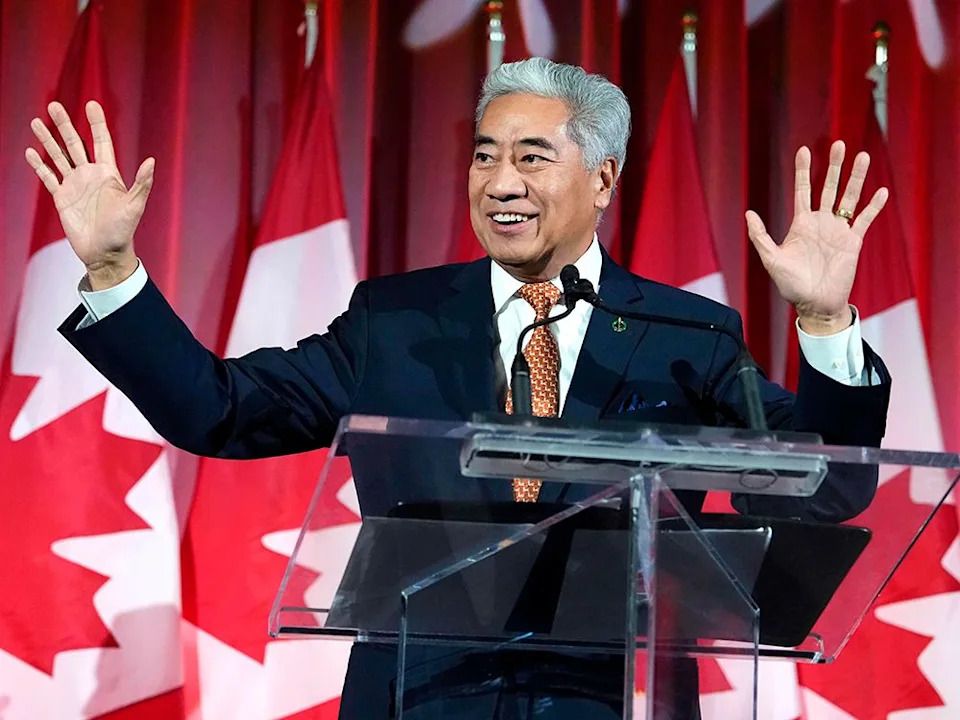
Markham-Unionville MP Michael Ma speaks briefly at the Liberal Party caucus Christmas party hours after crossing the floor from the Conservatives to the Liberals, in Ottawa, on Thursday, Dec. 11, 2025.
Expanding on the core four characteristics listed above, a more comprehensive list of traits to identify potential floor crossers, analysts say, could include elements from the following four clusters:
Electoral factors:
-
Won a very close race in the last election. A narrow constituency win can give an MP more reason to think he or she will have a better chance of holding on to a seat in the next election under a different banner. As with many of these factors, the latest opinion polls are usually paramount in motivating potential floor crossers. For example, Ma, a rookie MP, won Markham—Unionville in April for the first time by 3.6 percentage points after the Liberals had to replace their candidate mid-race.
-
Swing riding. Similar to the explanation above, an MP’s survival instinct may be more likely to intensify if their riding tends to go back and forth from one party to the next. The Liberals won Markham—Unionville in the previous election, in 2021, by almost six percentage points and Liberals have won more often there than Conservatives have.
-
Political culture. Sanjay Jeram, a political scientist at Simon Fraser University, said geography is very important in trying to predict possible floor crossers. Ontario is likely the best place to start looking in the current political landscape, he said, because there are more swing ridings, and crossers are less likely to face an angry, mobilized response than a party switcher in a Conservative heartland like Alberta. Five of the nine Conservative MPs on the Post’s list above are from Ontario.
-
Rookies. First-term MPs are seen as more likely to bolt their parties for one big reason: their pension. MPs are eligible to collect a full, lucrative pension at the age of 65 if they have served in Parliament for six years, which usually means two election wins. That makes rookie MPs highly motivated to do whatever is necessary to win a second election to hit that threshold.
Getting ahead:
-
Promotion: Analysts say floor crossers are almost always opportunists, not idealists trying to better serve their constituents. Sometimes they’re lured (openly or surreptitiously) with promotions, such as a seat at the cabinet table, to make the move. Those promotions sometimes don’t take effect until after the negative attention on the floor crossing has died down.
-
Opposition blues: Sometimes the opportunism is rooted in a desire to simply be on the team with the power. If opposition MPs who want to govern don’t see a likely path because of the party’s poll numbers or another factor, they are more likely to jump. One Conservative source said some of the rookie MPs in the Tory caucus were motivated to run for office because up until early 2025 it looked certain their party would form the next government; they might not feel like waiting on Opposition backbenches till the next election.
On a personal level:
-
Relationship with the leader: If an MP dislikes their party leader or feels disrespected or unappreciated, that could make it more likely the MP will think about switching sides. A poor relationship would also likely make it less likely that the MP would ever play a key role in a future government, so this can hurt their ambitions. Also, MPs are less enthusiastic about fighting political battles and putting in long hours for a leader they don’t get along with.
-
Relationships with the other side: The personal element can work the other way too. A strong relationship with somebody at or near the top of the acquiring party can also make a difference. This may be a rarity, but some reports had Liberal cabinet minister Tim Hodgson, from a neighbouring riding, playing a key role in recruiting Ma. And when David Emerson, previously a key member of the Liberal cabinet, crossed the floor to join the Conservative cabinet shortly after being re-elected in 2006 as a Liberal, the mutual respect between him and then prime minister Stephen Harper was seen as one of the factors.
-
Party roots: A rookie MP such as Ma, who doesn’t have deep roots in the party he ran for, is considered more likely to jump sides, as opposed to an MP who is a long-time loyalist and veteran of years of party battles.
-
Personal history: Conrad Winn, a political science professor at Carleton University in Ottawa, said an MP’s personal history is a critical element in working out if they might switch parties, particularly whether they have a history of betraying colleagues and others.
Policy options:
-
Points of view: Occasionally, floor crossers do cite a fundamental difference with the party or leader on a particular policy, or the party’s broader direction. In 2003, just days after the Progressive Conservatives and Canadian Alliance voted to merge, longtime MP Scott Brison crossed to the Liberals. Unlike many floor crossers, Brison had strong roots in the Conservative party and had once given up his seat so that Progressive Conservative leader Joe Clark could enter the House of Commons. But the Nova Scotia MP was seen as a “red” or moderate Tory in a party that had been rebuilt and whose centre of gravity had shifted to the right. He also said that as a gay man, he left the party in part because of the number of Tory caucus members who were against same-sex marriage.
Advertisement
Advertisement
Advertisement
Advertisement
No matter the motivations, does an MP or two really make that much difference in the math of who runs the country and what they do with that power?
Winn said it could help the Liberals in some ways if they get a majority but it’s not such a big deal. “I think the Carney people have bigger challenges than increasing the number of people in their caucus,” he said.
Beyond the preferred optics of holding a majority, however, the country’s two major political parties seem to think it’s important.
Lori Turnbull, a political scientist at Dalhousie University in Halifax, said the addition of a single MP can be important in situations such as the current Parliament, where the Liberals are just short of a majority, because it would mean, among other things, that legislation could be passed more easily. “I don’t think it’s an uneventful thing,” she said.
Advertisement
Advertisement
Advertisement
Advertisement
Ottawa watchers point to the fact that majority governments can control parliamentary committees, where opposition parties can otherwise slow the progress of legislation. Eleven of the Liberal government’s 20 legislative items are currently at second reading or committee consideration, required steps before becoming law.
The math isn’t overly complicated. The Liberals now have 171 seats in the 343-seat House, with the opposition parties combining for 172 (Conservatives: 142, Bloc Québécois: 22, New Democrats: 7, Greens: 1).
But with a bare majority of just one, every single MP has unusual power, with the ability to block legislation if they vote against their party. It also places extra pressure on every single member of the government’s caucus to vote when needed (which is easier these days, with MPs able to do so virtually).
While some parliamentary democracies, such as India, Bangladesh and South Africa, have banned or restricted floor crossing, it’s not uncommon in Canada, Australia and the United Kingdom. That doesn’t mean of course that floor crossers won’t pay a political price from voters.
Advertisement
Advertisement
Advertisement
Advertisement
But should it be allowed?
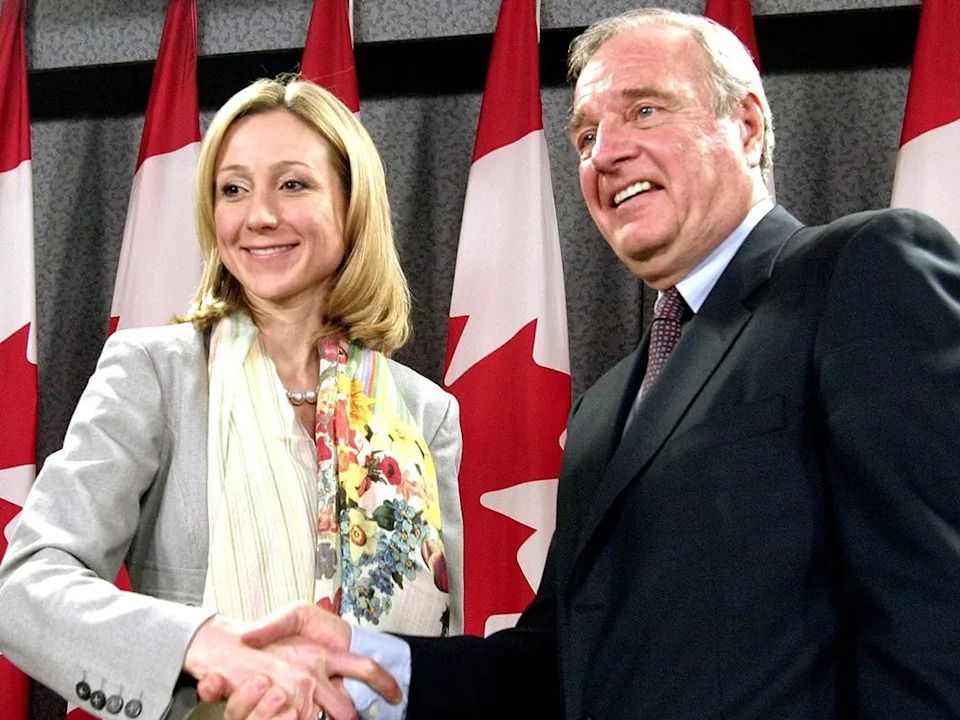
Former Conservative MP Belinda Stronach and Prime Minister Paul Martin hold a news conference to announce her defection to the Liberal Party in May 2005.
The main arguments in favour of allowing floor crossing is that it allows elected officials to follow their conscience or respond freely to emerging issues. The flip side is that voters may have supported a candidate in large part because of the party and the platform they said they believed in. Switching parties can also invite political bribes, such as promotions, not to mention opportunism.
Analysts and political veterans agree that floor crossers are almost always motivated mostly by personal gain, usually promotion or political survival, despite their usual claims to doing it to better serve constituents or the country under their new banner.
But it doesn’t always work out well for them in the longer term. Emerson faced heavy flak in his riding and retired from politics after one term with the Tories. Leona Alleslev, a former Air Force officer, joined the Conservatives from the governing Liberals in 2018 in a rare case of switching over policy and going from government to Opposition. She lost her seat a year later.
Advertisement
Advertisement
Advertisement
Advertisement
Stronach’s shocking decision to cross at the last minute to save a Liberal minority government from falling on a confidence vote, renewed calls for laws to prevent changing parties. The NDP requested an investigation of Stronach’s actions and her promotion into cabinet. A month after she joined the Liberals, a Conservative MP tabled a private member’s bill that would have necessitated that a byelection be held within 35 days of an MP switching parties, though it died on the order paper after second reading because of the 2006 election. Similar bills have also been tried, but haven’t gone anywhere.
Perhaps that’s because floor crossing is a longtime tradition in Westminster parliaments. In 1917, more than a century ago, when then Liberal leader Wilfrid Laurier refused to support overseas conscription during the First World War, a number of his MPs left his government to join Robert Borden’s Union government.
Legendary British Prime Minister Winston Churchill was perhaps the ultimate floor crosser. In 1904, he bolted the U.K. Conservatives for the Liberals over free trade and social policy. Twenty years later, he crossed back to the Conservatives as the Liberal party was in free fall.
“Anyone can rat,” the future prime minister said. “But it takes a certain ingenuity to re-rat.”
Advertisement
Advertisement
Advertisement
Advertisement
National Post
stuck@postmedia.com
Our website is the place for the latest breaking news, exclusive scoops, longreads and provocative commentary. Please bookmark nationalpost.com and sign up for our daily newsletter, Posted, here.
تم ادراج الخبر والعهده على المصدر، الرجاء الكتابة الينا لاي توضبح - برجاء اخبارنا بريديا عن خروقات لحقوق النشر للغير


