


اخبار العرب-كندا 24: الجمعة 9 يناير 2026 10:08 مساءً
A former Alberta energy minister says a proposed bitumen pipeline to the northwest B.C. coast is unlikely to materialize if Canada relies on the private sector alone to build it.
“I would say it's not just diminishing, the likelihood of a private sector proponent.… I would almost say it is zero at this point,” Sonya Savage said on CBC's West of Centre podcast.
The former United Conservative minister's caution comes as Premier Danielle Smith argued that Ottawa act with new urgency to green-light that pipeline, highlighting the U.S. capture of Venezuela leader Nicolas Maduro and prospect of increased oil development in that country as a new reason.
Advertisement
Advertisement
Advertisement
Advertisement
On Friday, Smith shared on social media a letter written to Prime Minister Mark Carney after meeting with him to discuss what's happening in Venezuela, whose heavy oil exports are similar to what the Alberta oilsands produce.
In it, she says Alberta intends to submit its application for a pipeline to the Major Projects Office by June — and she asked that it gets approved by this fall.
"Any delay risks ceding market share, losing investment, and undermining Canada's competitive position in a rapidly changing global energy landscape," Smith writes in the letter.
She also asked for regulatory approvals for all nation-building projects to be completed within six months.
Advertisement
Advertisement
Advertisement
Advertisement
Carney's major projects office, established last year, currently aims to complete regulatory reviews within two years.
Smith's letter calls that timeline "woefully long."
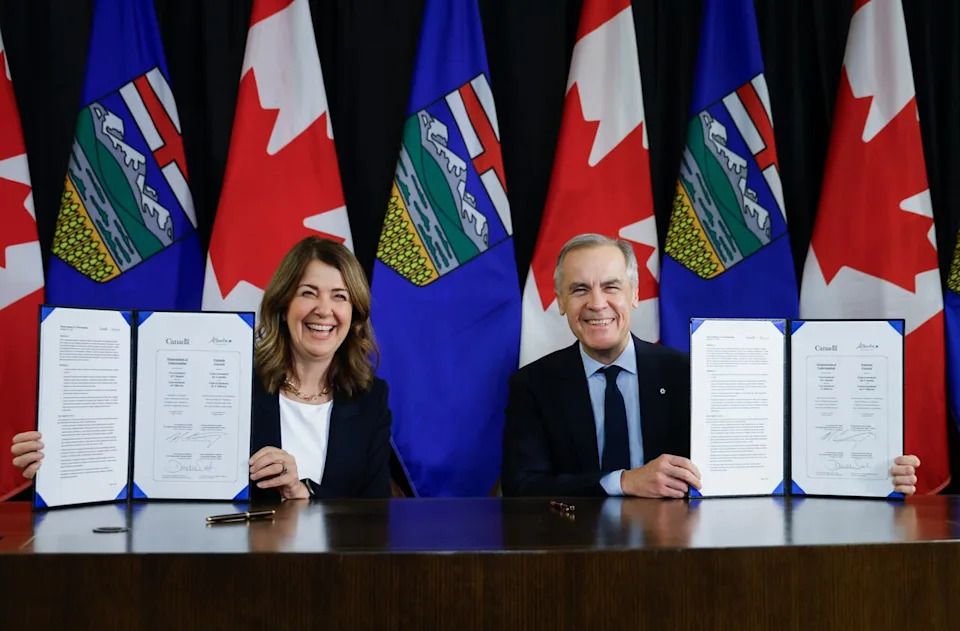
In November, Prime Minister Mark Carney and Alberta Premier Danielle Smith signed a memorandum of understanding (MOU) to collaborate on a new bitumen pipeline.
While Alberta intends to apply as the lead proponent, the agreement stresses that the project would be privately constructed and financed.
(Jeff McIntosh/The Canadian Press)
After the MOU was signed, industry watchers told CBC News that pipeline companies might want a financial commitment from Alberta or Ottawa to backstop cost overruns that are outside of a company’s control.
Advertisement
Advertisement
Advertisement
Advertisement
Savage, who has worked as a senior executive for the Canadian Energy Pipeline Association and Enbridge, said that is not a new concept for Canada.
“The TransCanada mainline gas line in the 1950s would not have been built without federal government intervention," said Savage.
"They set up a Crown corporation, they backstopped it. Enbridge’s Line 9 in the 1970s would not have been built without a federal government backstop.”
Though Alberta and Ottawa have referred to the northwest coast oil pipeline as “nation-building” infrastructure, that sentiment is not uniformly shared amongst Canada’s leaders.
Advertisement
Advertisement
Advertisement
Advertisement
WATCH | The full West of Centre discussion with Savage:
Earlier this week, B.C. Premier David Eby said if tax dollars are being considered, Canada should instead consider building a new oil refinery rather than a pipeline to the province's north coast.
“If we've got tens of billions of dollars to spend, I think we should spend it on a refinery and we should develop oil products for Canadians and for export, instead of being reliant on American and Chinese refineries to do it for us,” Eby said at a news conference Tuesday.
Savage said the economics of it do not make sense. Once refined, there would still need to be a way to get the oil to the coast, and then shipped to bigger markets.
Advertisement
Advertisement
Advertisement
Advertisement
"He's either energy illiterate, or he's trying to distract," she said. "At this point, I think he should just back out of the conversation."
The Canadian Press reached out to Carney's office, but no one wasn't immediately able to comment on Smith's calls for quicker project approvals.
Regarding Smith's concerns about the competitiveness of Canadian oil, the Prime Minister's Office pointed to comments he made earlier this week in France.
Carney told reporters in Paris on Tuesday that he thought Canada's oil would remain competitive because it is low-risk and low-cost.
Canadian energy stocks tumbled after the Venezuela upheaval. Oil prices have been on a downward trend since the start of last year.
With files from Jennifer Keiller and The Canadian Press
تم ادراج الخبر والعهده على المصدر، الرجاء الكتابة الينا لاي توضبح - برجاء اخبارنا بريديا عن خروقات لحقوق النشر للغير


