




اخبار العرب-كندا 24: الخميس 1 يناير 2026 07:08 صباحاً
The month of January starts off with the last of four supermoons, plus bright meteors flashing across the sky!
Keep looking up throughout the month, though, as the two largest planets in the solar system shine among the winter constellations.

Astronomy Calendar - January 2026
The calendar of astronomical events for January 2026, including the phases of the Moon, when the Moon can be seen near bright planets, and the peak of the Quadrantids meteor shower. (Scott Sutherland/NASA SVS/Stellarium)
READ MORE: Eyes to the winter sky for meteor showers, a supermoon and a total lunar eclipse
The Moon
On the very first day of the month, it may look like we have a Full Moon shining in the sky. However, we will need to wait until the next night, on January 2-3, to see the Full Wolf Supermoon rise.
Advertisement
Advertisement
Advertisement
Advertisement
Given that this is the last of a string of four supermoons, which began in October 2025, it will look bigger and brighter than normal. According to retired NASA scientist Fred Espenak, it will be around 13 per cent brighter than an average Full Moon, and over 25 per cent brighter than the farthest Full Moon of the year (in late May).
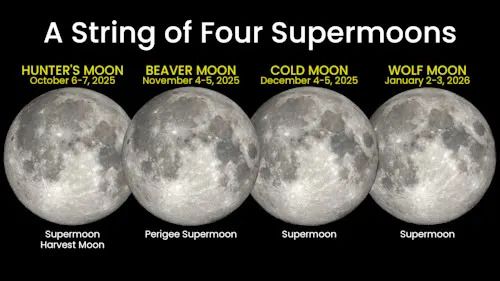
Four Supermoons - 2025-2026
Four supermoons occur in a row from October 2025 through January 2026. (NASA SVS/Fred Espenak/Scott Sutherland)
However, the Moon will appear Full (over 98 per cent illuminated) from the predawn hours on the 1st through until the morning of the 4th.
In the days that follow, we will see less and less of the Moon each night, as it transitions through its Waning Gibbous phases until the Last Quarter on the 10th. Afterwards, the Waning Crescent Moon will be seen in the eastern sky, predawn, becoming thinner and thinner until the New Moon on the 18th. Then, the Waxing Crescent will reappear in the western sky after sunset starting on the 19th, climbing higher each night for a week, followed by the First Quarter on the 26th. The Waxing Gibbous Moon will shine each night from then until the end of the month, prepping for the next Full Moon on the first night of February.
READ MORE: Why is the supermoon so compelling to us?
The Planets
Throughout January, two planets will shine in the sky.
Advertisement
Advertisement
Advertisement
Advertisement
Jupiter will cross the sky each night, 'hanging out' near Pollux and Castor, the brightest stars of the constellation Gemini. Look up on the night of January 4, specifically, to see the planet very close to the Waning Gibbous Moon.
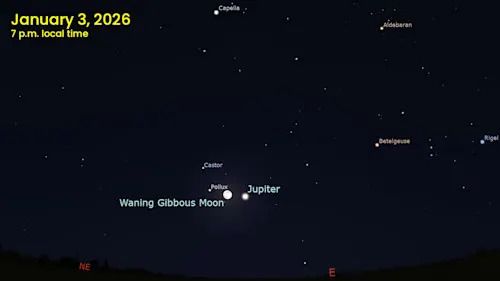
Jan 3 2026 - Moon Jupiter
Jupiter and the Waning Gibbous Moon in the eastern sky after sunset on January 3, 2026. (Stellarium/Scott Sutherland)
Also, if you've noticed Jupiter getting brighter over the past weeks, you're right! Earth is drawing closer and closer to the giant world, as we near the astronomical alignment known as Jupiter Opposition.
On the night of January 9-10, Earth will align perfectly between Jupiter and the Sun, with each on opposite sides of our planet. At this time, Jupiter will be at its brightest of the past year, and we won't see the planet this bright again until 2032!
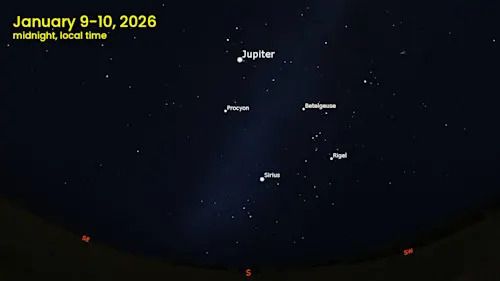
Jupiter Opposition 2026
Look to the west in the hours after sunset and the planet Saturn will be there, not shining as brightly as Jupiter, but still one of the brightest objects in that region of the sky.
Advertisement
Advertisement
Advertisement
Advertisement
Saturn will be easiest to locate on the nights of the 22nd and 23rd, as the planet will be close to the Waxing Crescent Moon in the western sky.

Jan 22-23 - Moon Saturn Overlap
The positions of the Waxing Crescent Moon, in relation to the planet Saturn, in the western sky after sunset, at around 8 p.m. local time on the nights of January 22 and 23, 2026. (Stellarium/Scott Sutherland)
In the above image, the western sky at 8 p.m. on the 22nd and 7:56 p.m. on the 23rd have been overlapped on top of each other, thus matching the positions of the stars on both nights. Saturn moves only the tiniest fraction of a degree between the two nights, but the Waxing Crescent Moon shifts from just below and to the right of Saturn, to almost directly above the planet the next night.
In the last few nights of the month, we can again find Jupiter and the Moon near each other, but this time it is the Waxing Gibbous Moon. Find them very close together on the night of the 30th.
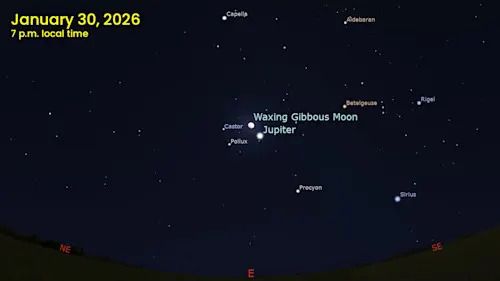
Jan 30 2026 - Moon Jupiter
Jupiter and the Waxing Gibbous Moon in the eastern sky after sunset on January 3, 2026. (Stellarium/Scott Sutherland)
The best winter meteor shower
From the end of December through the middle of January, Earth passes through a stream of debris in space left behind by an extinct comet. Each time we fly through this stream, meteors flash through the sky, which all appear to originate from a point centred between the constellations Boötes, Hercules, Draco, and Ursa Major.
Advertisement
Advertisement
Advertisement
Advertisement
This is the Quadrantid meteor shower, and it reaches its peak on the night of January 3-4.
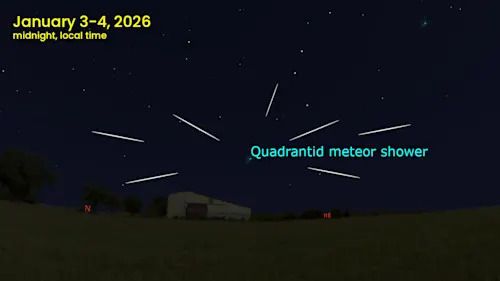
Quadrantid meteor shower - 2026
The radiant of the Quadrantids, in the northeastern sky, at midnight local time, on the night of January 3-4, 2026. (Stellarium/Scott Sutherland)
The Quadrantids radiant (the point in the sky where the meteors appear to originate from) never truly sets at this time of year. So, we only need to wait until the Sun sets, and it is sufficiently dark, for the show to begin.
The Quadrantids tend to be just as strong as the Perseids, delivering between 75 and 100 meteors per hour during the peak. However, while the Perseids can put on a good show for much of the night, the Quadrantid peak typically only lasts a few hours.
Advertisement
Advertisement
Advertisement
Advertisement
According to the International Meteor Organization (IMO), in 2026, the Quadrantids are expected to peak late in the afternoon for Canada. That means we'll likely see more meteors in the evening hours, when the radiant is fairly low in the northern sky.
However, the Quadrantids peak is not timed very well this year, as it occurs the night after the Full Moon. Thus, the bright light from the Waning Gibbous Moon will 'wash out' the sky, significantly reducing the number of meteors we can see.
There are ways to maximize the number we see, though. If you have clear skies that evening, go out once it gets sufficiently dark, and scan northwest the sky for the bright star Vega. Face in that direction (northwest), and then look straight up, taking in as much of the sky above as possible, while keeping the Moon out of your direct line of sight.
READ MORE: How to get the most out of meteor showers and other night sky events
January Constellations
Throughout the year, our night sky changes, with different stars becoming visible or slipping out of view, based on where we are positioned along our orbit around the Sun.
Advertisement
Advertisement
Advertisement
Advertisement
In January, the winter constellations dominate the celestial sphere. The most prominent ones include Orion, Gemini, Taurus, Auriga, Canis Major, Canis Minor, Carina, Eridanus, and Monoceros.
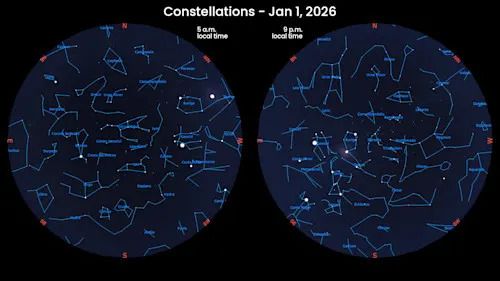
January 1st 2026 - Constellations - allsky
The constellations visible in the morning and evening skies on January 1, 2026. (Stellarium/Scott Sutherland)
The most recognizable constellations at this time of year will be Orion and Gemini. Both rise in the east with the setting Sun and cross the sky to set in the west before sunrise.
To the north, Ursa Major and Ursa Minor (the Big Dipper and the Little Dipper, respectively) can easily be picked out, along with W-shaped Cassiopeia.

January 31st 2026 - Constellations - allsky
The constellations visible in the morning and evening skies on January 31, 2026. (Stellarium/Scott Sutherland)
Advertisement
Advertisement
Advertisement
Advertisement
Also be on the lookout for the Winter Triangle, an 'asterism' made up of three of the brightest stars in the sky — Betelgeuse, as the right-hand shoulder of Orion, Sirius, the brightest star in the northern sky, and Procyon, in the constellation Canis Minor.
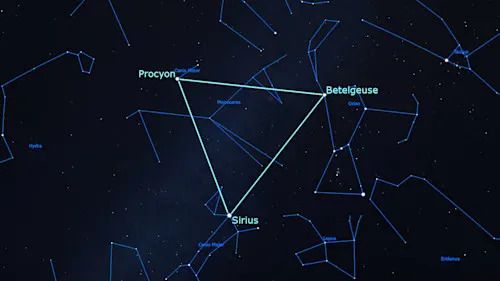
Winter Triangle - Jan 15 2026 - Stellarium
The Winter Triangle. (Stellarium/Scott Sutherland)
Winter Forecast Re-Release: Canada's active and cold winter persists
Click here to view the video
تم ادراج الخبر والعهده على المصدر، الرجاء الكتابة الينا لاي توضبح - برجاء اخبارنا بريديا عن خروقات لحقوق النشر للغير


