


اخبار العرب-كندا 24: الاثنين 29 ديسمبر 2025 04:08 صباحاً
Internal documents obtained by CBC Ottawa show how city manager Wendy Stephanson planned to defend her controversial decision to mandate municipal employees back to the office full-time, but are scarce on details about how that decision was made.
Now, critics are questioning the city’s transparency during what's been described as a “chaotic” process, while one councillor notes they’ve still not seen the research and evidence Stephanson relied on to mandate the policy — one made just a week after Premier Doug Ford’s own mid-August mandate announcement for provincial employees.
When Stephanson publicly announced her decision on Aug. 26, she said it wasn’t politically motivated but designed to bolster “organizational culture.”
Advertisement
Advertisement
Advertisement
Advertisement
The city reiterated the policy — which begins in January — would impact a minority of its workforce, as most employees had already returned.
CBC News requested all internal correspondence to and from Stephanson and her team regarding the new mandate from Aug. 1 to Sept. 11.
Despite the broad request — one that covered city staff, councillors and officials from other levels of government — the city manager’s office produced three pages: a single email exchange between Stephanson and Kitchissippi Coun. Jeff Leiper.
That Sept. 9 exchange focused on the wording of Leiper’s motion to reverse the mandate. The motion was later blocked by a surprise replacement motion at council.
Advertisement
Advertisement
Advertisement
Advertisement
CBC then requested a secondary search, noting the request covered a critical period related to a contentious mandate.
That secondary search uncovered 52 pages, but no internal correspondence involving Stephanson and staff that would shed light on how the decision was made.
A similar pattern was seen in a follow-up request covering Sept. 12 to 23, a period when Stephanson clarified there would be “continued flexibility” amid reported “confusion.”
Only 15 pages were initially disclosed. A secondary search resulted in 36 pages then being sent to CBC.
About 14 pages were "exempted" under the Municipal Freedom of Information and Protection of Privacy Act, which holds back records that are related to labour relations or employment matters “in which the institution has an interest.”
Advertisement
Advertisement
Advertisement
Advertisement
That can include meetings, discussions or consultations.
Disclosed documents from both requests largely consist of complaints from members of the public, emails from councillors, a lobby request from a workplace culture specialist, and communication briefings to help Stephanson answer media and councillor questions.
Those briefing notes offer a glimpse into how the city manages its public image but little on internal deliberations.
According to the city’s accountability and transparency policy, “decision-making is open and transparent.”
Staff and managers also have a legal “duty to document” under its records management policy, which states that good recordkeeping “provides evidence of decisions and decision-making,” and “assures the protection of the public’s right to access information.”
Advertisement
Advertisement
Advertisement
Advertisement
The city declined CBC’s interview request with Stephanson. In a statement, the city wrote "human error and differences in interpretation" can occur when staff respond to records requests.
Consultation, evidence still lacking: councillor
“Consultation was done,” Stephanson said during the Sept. 24 council meeting.
In her prepared talking points for that meeting, a subhead reads: “How the decision was made —consultations.”
It goes on to prompt Stephanson to explain her “outreach efforts” throughout the year with community partners and councillors, and how she “heard from employees about a need for increased opportunities for in-person engagement” to strengthen relationships and foster “deeper sense of connection and belonging” at work.
Advertisement
Advertisement
Advertisement
Advertisement
Another subhead titled “research” included three lines about how research she reviewed supports both hybrid and in-office approaches.
“There is no one right approach or answer,” her brief reads.
Gloucester-Southgate Coun. Jessica Bradley filed a formal inquiry to Stephanson on Aug. 27, requesting “specific research, data, and evidence” that informed the mandate decision, as well as a “detailed analysis” on how the policy aligns with the city’s strategic priorities to remain a competitive employer.
Under the city’s procedural bylaw, administration is required to produce a response to such inquiries. It must then be shared with council and recorded as a public document.
Advertisement
Advertisement
Advertisement
Advertisement
Nearly four months later, Bradley said she had not received a response.
“If there was evidence that informed this decision, we would have that by now,” Bradley said.

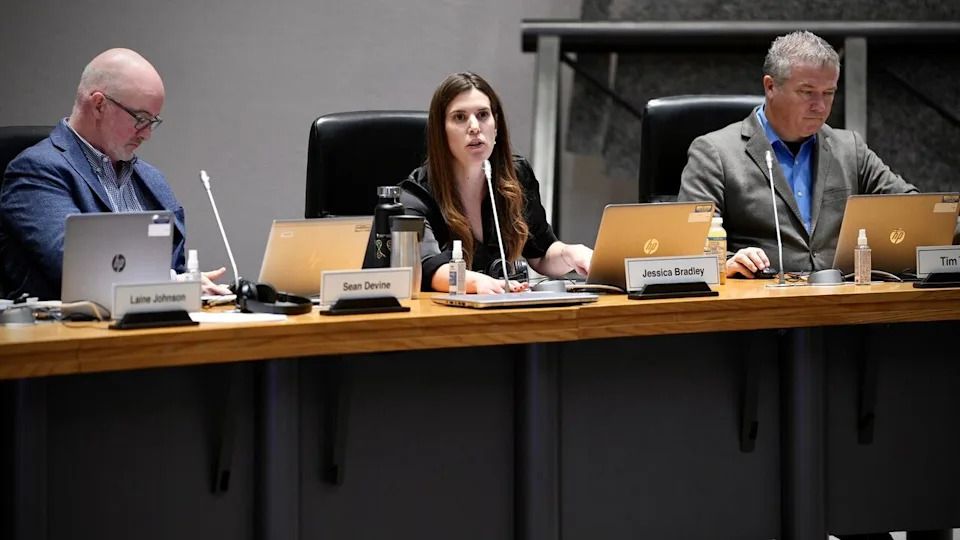
Coun. Jessica Bradley, left, at council. The councillor submitted a formal inquiry on Aug. 27, asking for 'specific research, data, and evidence' that informed the mandate decision. Nearly four months later, Bradley said she had not received a response. (Félix Desroches/CBC)
“I can only make good decisions with good information, which is why I had hoped that there would be evidence to support this,” she added. “So to me, it tells me that there wasn't a lot of research or evidence."
Bradley said while she'd had meetings with Stephanson to discuss various community issues, none were specific to the return-to-office mandate.
CBC asked the city to provide the dates and the format in which employees were consulted —for instance, surveys or round-table discussions — as well as the names of community partners and councillors who were consulted prior to Stephanson's decision.
Advertisement
Advertisement
Advertisement
Advertisement
The city did not answer this question.
‘Chaotic process’ on the ground: union
Peter Bleyer, executive director of the Civic Institute of Professional Personnel (CIPP), said he’d like to give Stephanson the benefit of the doubt on her consultation efforts, but pointed out a significant gap.
“The one organization that she had a responsibility and an obligation to consult with because of a contractual arrangement, she did not,” Bleyer said. “And that is our union.”
CIPP represents a majority of hybrid workers in the city and is currently in collective bargaining.
Bleyer said it’s been a “chaotic process” for employees to make alternative work arrangements because of changing deadlines.
Advertisement
Advertisement
Advertisement
Advertisement
“And frankly, that confusion and frustration continues to this day,” he said, adding employees are making difficult last-minute arrangements at home on issues like child care.
Despite the city’s new in-office standard, Bleyer says the reality on the ground appears to be a patchwork of interpretations.
The implementation "fluctuates depending on what department they’re part of,” Bleyer said, noting that some teams are reportedly planning to stay at two or three in-office days come Jan. 1, due to a lack of physical office space.
“It is frustrating because all we've been looking for all along is clarity, consultation, rationales ... and that isn't really the way this played out,” Bleyer said. “Our feeling remains, and I think it's shared by most people, that this was political.”
Advertisement
Advertisement
Advertisement
Advertisement
Bradley also noted hearing of "inconsistent" application of the standard.
"My concern for the organization is that there's going to be a lot of resentment."
Peter Bleyer, CIPP executive director, says departments and teams vary in interpreting the new in-office standard. (Felix Desroches/CBC)
'Human error' happens, city says
In a written statement, the city explained staff must conduct "a reasonable search for records" when they get an access to information request, but "what is considered reasonable can vary based on the nature and scope of the request."
"While we make every effort to ensure searches are thorough, access requests are handled by people and, on occasion, human error or differences in interpretation can occur," wrote Kiel Anderson, manager of governance, elected officials and business support.
Advertisement
Advertisement
Advertisement
Advertisement
"When this happens, we take immediate steps to review and complete the search as thoroughly as possible, including through a secondary search process.”
The city wrote its in-office standard will start on a five-day schedule "to improve workplace culture" and service delivery, and reiterated its commitment to being flexible for hybrid work on a case-by-case basis.
تم ادراج الخبر والعهده على المصدر، الرجاء الكتابة الينا لاي توضبح - برجاء اخبارنا بريديا عن خروقات لحقوق النشر للغير


