



اخبار العرب-كندا 24: الثلاثاء 23 ديسمبر 2025 11:32 صباحاً
Vandhana Mohanraj and her partner Faisal Fakhani had just finished their regular grocery run when the couple decided to stop for coffee.
At the storefront for the fledgling Caffeo shop in downtown Toronto, Mohanraj punched in her choice – a vanilla latte – and tapped her card on the payment pad. Then the café’s “barista” went to work.
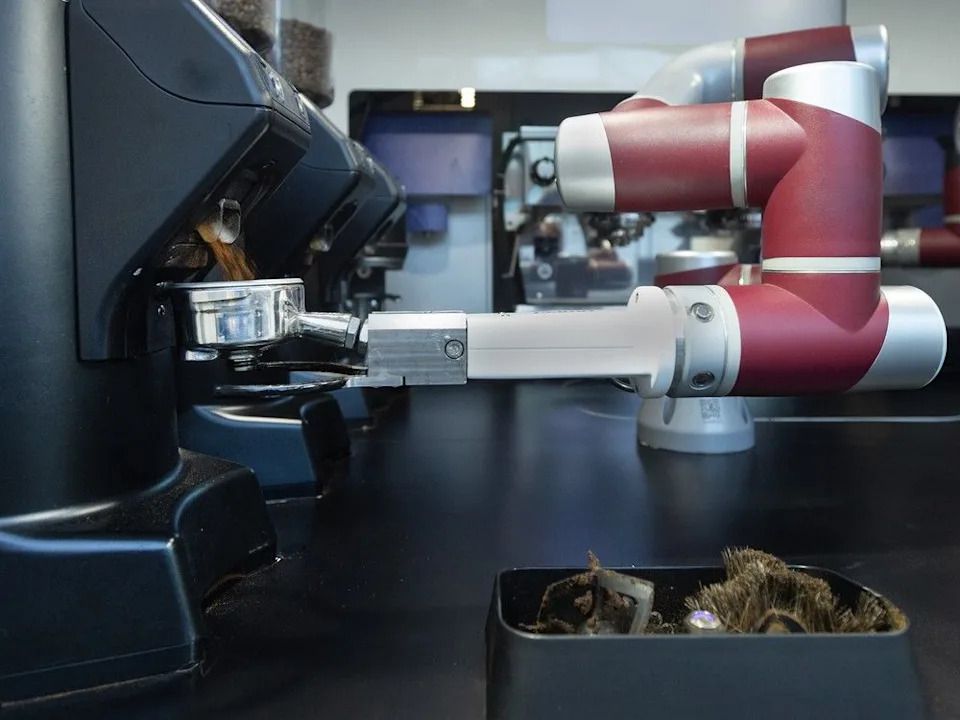
Behind the plate-glass window, an all-arms robot filled the metal filter basket with fresh grounds, inserted it into an espresso machine, then topped the resulting coffee with steamed milk.
Advertisement
Advertisement
Advertisement
Advertisement
Mohanraj sipped her first android-prepared brew and smiled. Fakhani took a swig and agreed with Mohanraj’s assessment – surprisingly good.
“We have a (human) barista who is always burning our lattes,” he said. “This is not burnt.”
Caffeo’ all-arms robot fills a basket with fresh grounds.
Flesh-and-blood employees, a once-obligatory element in the service industry, were nowhere to be seen. Caffeo is just one small example of an intriguing trend: retail-level enterprises that harness technology to operate without customer-facing staff.
Across Canada, there are convenience stores with no clerks, hotels where guests check in, check out and order fresh towels on their smart phones, and gyms and virtual golf driving ranges that run on a completely self-serve basis.
Advertisement
Advertisement
Advertisement
Advertisement
And the idea, a sort of bricks-and-mortar parallel to the artificial intelligence revolution, is certain to keep expanding, analysts and entrepreneurs say.
“Everyone’s looking at ways to cut costs or to navigate the skills shortage,” says Wendy Cukier, a Toronto Metropolitan University professor and expert on disruptive technologies. “In the absence of available labour, more and more companies are looking at ways to automate functions.”
Some of the technology has been around for years. Pharmacies, supermarkets, cinemas and others have long allowed customers to pay for their products at self-serve kiosks. Lately, a few businesses have backed away from the terminals because of theft concerns and customer objections, but they remain ubiquitous.
Eliminating the cashier, drinks-maker or front-desk clerk entirely may be the inevitable next step.
Advertisement
Advertisement
Advertisement
Advertisement
It could be especially appealing to service-sector employers who have grown reliant on temporary foreign workers or international students to fill jobs that others balk at or avoid because of the low wages, said Cukier.
As for Canadian consumers, many seem well-primed for service by machine in places where human contact would once have been a given, say the operators of staffless outlets.
“There is definitely a subset of people that don’t want to talk to some frontline service staff,” said Tason Lee, CEO of the Tracer Golf golf-simulator company. “They don’t want to feel that pressure. They’re kind of in that online world where they can buy something off a website and expect it to be here and that’s it.”
These businesses still need some humans, naturally, to carry out management and certain physical tasks. For now, at least. Lisa Hutcheson of JCWG Retail Consultants said she recently saw a demonstration of robots that can actually stock store shelves.
Advertisement
Advertisement
Advertisement
Advertisement
“Will it completely eliminate the need for people? I don’t think so,” said Hutcheson. “(But) there’s a place for it. We’ll continue to see various different models of it. I think it’s here to stay.”
Aisle24, with over 30 cashierless convenience stores in Newfoundland, Nova Scotia, Ontario, Alberta and British Columbia, is a Canadian pioneer, its first outlet opening in 2016. For CEO and founder John Douang, the automated retail model seemed like a natural, even necessary, evolution from the type of corner store his parents ran as he grew up. They worked 16-hour days, often just manning the cash register, employed Douang and his siblings part-time and had to shut down and lose revenue just to go on vacation, he recalls.
“A lot of the time, from my own experience, the cashier just sits there, waiting for customers to come in,” said Douang, a software engineer. “Our goal wasn’t ‘Hey, let’s slash all the jobs.’ It was ‘Let’s make it more efficient so we can repurpose that labour sitting there.’ ”
Aisle 24 is cashier-less, unattended, and open 24/7.
Aisle24 customers download the company app, which allows them access to the locked stores. Then they shop and check out at self-serve scanners. As part of the sign-up process, “members” upload a selfie photograph. If they leave without paying, the raft of cameras in the store, coupled with facial-recognition software, allows the system to alert clients if they made an honest mistake — or take other action if theft is suspected.
Advertisement
Advertisement
Advertisement
Advertisement
He sees the concept as a physical, yet technology-driven, answer to the massive popularity of online shopping.
“E-commerce has been taking a big chunk of retail for a long time,” he said. “The newer generation of Gen Zs and Gen Alphas are very much accustomed to the digital aspect of life, and businesses really need to think about that. They need to adapt.”
At Ontario’s Trent University, the idea has been taken a step further. The campus’s Bata Bean café and market uses Amazon’s JustWalkOut software, which detects the goods customers leave with and automatically charges their accounts.
The same technology is being used at Toronto’s Scotiabank arena, home of the Raptors and Maple Leafs, allowing customers to tap their card, take the drink or snack they want and leave without waiting for a human to cash them out. Blue Jays fans can do much the same at the nearby Rogers Centre, which is equipped with a similar system supplied by a firm called Zippin.
Advertisement
Advertisement
Advertisement
Advertisement
In Quebec City, Manoir des Remparts is among establishments that have transformed the traditional hotel routine, offering a “staffless operation” that has guests check in and out and contact company employees via their smartphones. Human housekeeping staff, of course, are still needed.
It’s an approach that was also employed until recently by a much larger concern, the Sonder hotel chain. That firm, founded in Montreal and once valued at more than $1 billion, suddenly went out of business in November, shuttering scores of hotels and apartments worldwide for financial reasons. Its demise seemed unconnected, however, to its use of automation.
The fitness club has, in some instances, also done away with in-person service people. Train by FW, a brand of B.C.’s Fitness World, is a 24-hour “micro-gym” that runs on a “staffless model,” its website indicates, but can be used by independent trainers and their clients. Xscape Fitness and Recovery in Belleville, Ont., also operates “staffless,” with access around the clock through a smartphone app, though personal trainers are available.
There is definitely a subset of people that don’t want to talk to some frontline service staff,
Advertisement
Advertisement
Advertisement
Advertisement
Tason Lee, CEO, Taser Golf
Tracer Golf is part of a growing industry of virtual golf practice facilities, where electronic devices measure the speed, angle and other aspects of a player’s swing to deduce the flight and distance of the balls they hit. An animated video of the result is projected on a screen.
Some competitors have combined the equipment with bars, restaurants and other amenities. Tracer stripped down the model instead to make it more affordable. Golfers book their practice bay online and use a smartphone to unlock the front door to facilities that have no on-site staff. The equipment in their bay automatically comes to life at the time they reserved and shuts down when the session is over. Tracer’s eight employees, who service nine locations spread throughout the Toronto area, and handle customer inquiries by intercom or phone, mostly work remotely.
CEO Lee says he expects the fully self-serve concept will expand, at least for certain services that can be readily automated.
Advertisement
Advertisement
Advertisement
Advertisement
Lee concedes the trend could mean less paid work.
“I have kids so it’s something I think about — what kind of jobs are they going to have?” he says. “If you keep going down that thought path, it can be scary.”
Cukier places the staffless service-industry trend in the broader context of artificial intelligence, which includes “physical AI” like intelligent robots. Though she was once a skeptic about its impact, she now sees the technology potentially replacing almost any type of worker.
“It doesn’t matter where I go,” said the author of Innovation Nation: Canadian Leadership from Java to Jurassic Park, “I feel that people are asleep in terms of how fast change is coming.”
Advertisement
Advertisement
Advertisement
Advertisement
It’s change that’s even coming to the retail coffee business. Caffeo’s gear is made by Jaka Robotics, a Chinese company that also supplies the likes of Toyota. Using it to assemble an espresso-based beverage, said Fakhani, was “less charming” than visiting an independent coffee shop, a couple of doors away. But the experience compares favourably to chain cafés like Tim Horton’s and Starbucks, he said.
Bottom line, next time he and Mohanraj are lugging their groceries home they’ll probably stop for a robot latte.
Our website is the place for the latest breaking news, exclusive scoops, longreads and provocative commentary. Please bookmark nationalpost.com and sign up for our daily newsletter, Posted, here.
تم ادراج الخبر والعهده على المصدر، الرجاء الكتابة الينا لاي توضبح - برجاء اخبارنا بريديا عن خروقات لحقوق النشر للغير


