



اخبار العرب-كندا 24: السبت 13 ديسمبر 2025 07:20 صباحاً
Reviews and recommendations are unbiased and products are independently selected. Postmedia may earn an affiliate commission from purchases made through links on this page.
The U.S. election had just ended and Pete Hoekstra was on a bit of a high. He’d taken charge of a divided Republican Party in Michigan and, with his team, helped steer the key battleground state to Donald Trump.
Now he was asking Trump’s people about possible jobs in the new administration.
Advertisement
Advertisement
Advertisement
Advertisement
They had a simple response: talk to the president-elect himself. Hoekstra dutifully called Trump on his cell phone and won an invitation to the Mar-a-Lago estate – the next day.
Hoekstra and his wife Diane drove three hours from their own home in Florida to the Palm Beach compound and soon enough the former congressman was sitting down with Trump.
“He said, ‘What do you want to do?’ I said, ‘I think I see myself as your ambassador to Canada,’ ” Hoekstra recalled in a recent interview. “He had kind of a quizzical look … and he says ‘I like that, I like that idea.’ ”
Within three hours of their encounter last November, the next president of the United States had announced on Truth Social the name of his new ambassador to Canada.
Advertisement
Advertisement
Advertisement
Advertisement
But if getting the job was strikingly smooth-sailing, actually doing it has turned out to be a little different.
Hoekstra has raised the profile of the American ambassador to Canada to seemingly unprecedented heights – and regularly courted controversy and criticism in the process.
He’s publicly voiced bafflement at why Canadians are angry at Trump for imposing devastating tariffs and urging this country to become the 51st state, suggested Canada’s response to Trump’s actions has been “nasty and mean” and reportedly aimed an expletive-laden rant at Ontario’s trade representative in front of a crowd of stunned onlookers.
One academic expert calls him the most contentious ambassador the U.S. has ever dispatched here, while others see Hoekstra as a sort of diplomatic embodiment of the pugnacious president he represents.
Advertisement
Advertisement
Advertisement
Advertisement
“For the first time, it appears that the American ambassador’s audience in everything he says publicly is the president,” said Flavio Volpe, president of Canada’s Automotive Parts Manufacturers’ Association. “He is very likely making his boss happy, while he makes the rest of us uneasy … He’s not a traditional ambassador. He’s not from central casting.”
There have been sharper assessments, too.
“Dear Canada: beware,” proclaimed the left-wing Common Dreams website in March. “Hoekstra deserves to be treated as a hostile guest.”
But the ambassador – who is personable and unassuming in one-on-one conversation – makes no apologies for the abruptness of his approach. Some might call it undiplomatic; he sees it as injecting a bit of straight-talking fresh air into a sometimes-obtuse diplomatic culture.
Advertisement
Advertisement
Advertisement
Advertisement
“I’m not only Dutch, I’m Frisian, which they call the most stubborn and blunt group – and the Dutch pride themselves on being blunt,” he said. “(That) is pretty valuable as a diplomat … I don’t think (Canadian officials) leave the meeting saying ‘What was he trying to tell us? Do you think Trump is really serious about tariffs?’ ”
Nor is his approach to the job entirely surprising.
Hoekstra was a prominent figure in U.S. national politics, chairing the important House of Representatives intelligence committee from 2004-2007 and meeting with world leaders from Muammar Gaddafi to Vladimir Putin.
But as a conservative Republican lawmaker, think-tank pundit, author and diplomat, he has often been in sync with Trump’s worldview, a loyal backer of the businessman’s presidential career – and unafraid to plunge into hot water.
Advertisement
Advertisement
Advertisement
Advertisement
While warning about the threat of “radical Islam,” he asserted repeatedly that Europe was spotted with Muslim “no-go zones,” a claim that would backfire in his first ambassadorial job in the Netherlands. He has said American “government schools” were being used “to indoctrinate our children with Marxist ideology.” And in a losing bid for a U.S. Senate seat, he ran a TV ad that critics blasted as racist.
Hoekstra is also listed as a contributor to Project 2025, the provocative right-wing blueprint for government that Trump distanced himself from during last year’s election but has mirrored extensively in his policies since taking power.
Steve Emerson, who made Hoekstra a fellow of his Investigative Project on Terrorism, describes his friend as independent-minded.
“He was just a brilliant guy and a can-do guy who just wanted to get things done,” said Emerson. “He is an original thinker. He’s not conventional at all in so far as policies or in terms of ideology. He thought outside the box, which I really admired.”
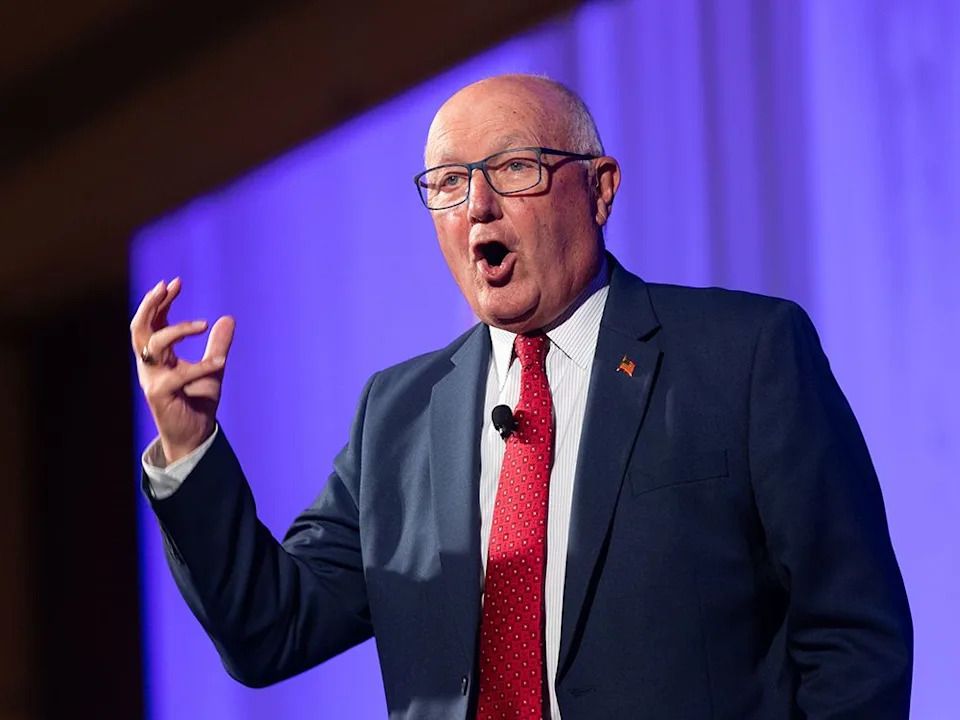
U.S. Ambassador to Canada Pete Hoekstra delivers a monologue before taking part in a discussion on Canada-U.S. relations during the Global Business Forum in Banff, Sept. 25, 2025.
Hoekstra is certainly a staunch advocate for his country, too, but the 72-year-old was actually born in the northern Netherlands city of Groningen, before his family emigrated and settled in Michigan when he was three.
Advertisement
Advertisement
Advertisement
Advertisement
After undergraduate and MBA degrees and rising to be vice president of marketing at office-furniture maker Herman Miller he turned his attention to politics, first winning election to the House of Representatives in 1992.
He was a founding member of the Tea Party caucus, home to some of the most conservative Republicans in Congress. Hoekstra himself had a voting record that in Canada would place him on the rightward edge of mainstream politics, opposing abortion rights, same-sex marriage, gay adoption, gun control and paid parental leave for federal employees.
But he made his name on the intelligence committee and has said that in the decade after the 9/11 attacks he spent “almost all of my time” on intelligence matters. Hoekstra’s focus became what he once termed America’s “greatest threat”: the rise of “radical Jihad, radical Islamists.”
It led to some unexpected bedfellows.
Advertisement
Advertisement
Advertisement
Advertisement
At the invitation of the George W. Bush administration, he met with the late Libyan dictator Gaddafi in 2003, then twice afterward. As he recounts in his book, Architects of Disaster: The Destruction of Libya, Gaddafi had been a brutal dictator and one of the world’s most prolific backers of terrorist acts, including the 1988 bombing of a Pan Am jumbo jet over Lockerbie, Scotland.
But the encounters were a resounding success, Hoekstra says, part of U.S. efforts that convinced the brutal strongman to become a de-facto ally of the States. That meant giving up his nuclear-weapons program, compensating victims of the Pan Am attack and, especially, helping combat violent Islamic extremists.
“Yes, Muammar Gaddafi was a monster,” Hoekstra conceded in his book. “But he was our monster.”
Gaddafi was a monster. But he was our monster
Advertisement
Advertisement
Advertisement
Advertisement
Today, he remembers surprisingly productive sessions with the Libyan despot.
“Gadaffi was very rational … You don’t sit there and think ‘I’m talking to a crazy guy,’ ” says Hoekstra. “He’s making rational, realistic arguments and you could have a good discussion with him.”
In fact, he argues in his book that President Barack Obama made a colossal mistake when he decided to aid Libyan opposition forces, spearheading a NATO air campaign that included Canadian CF-18s and bringing about Gadaffi’s downfall and death. The ensuing leadership vacuum led to chaos, civil war and fertile ground for terrorists, Hoekstra says, with an ambassador and three other Americans at the U.S. mission in Benghazi falling victim to a 2012 militant attack.
Hoekstra also voted in favour of the 2003 U.S. invasion of Iraq, which itself led to a bloody insurgency that killed 4,400 Americans and an estimated hundreds of thousands of Iraqis, while helping sow the seeds of the Islamic State terror group.
Advertisement
Advertisement
Advertisement
Advertisement
Hoekstra stayed on the radical-Islam beat after his career in Congress ended in 2011, working with Emerson’s Investigative Project on Terrorism, then writing the Libya book.
He often warned against the United States following the example of western Europe, which he said had naively allowed Islamists a foothold there.
“Chaos in the Netherlands. There are cars being burned. There are politicians that are being burned,” he said at a 2015 panel discussion called Muslim Migration into Europe: Eurabia Come True? “With the influx of the Islamic community … there are no-go zones in the Netherlands. All right? There are no-go zones in France … There are no go zones in Britain as well, but they are tearing the Dutch apart politically.”
Hoekstra also made two attempts at statewide office, first losing the Republican primary for the Michigan governor’s post, then battling Democrat Debbie Stabenow for a seat in the U.S. Senate. He fell short in that one, too, and sparked controversy with a commercial that depicted a stereotypical Chinese peasant speaking in broken English.
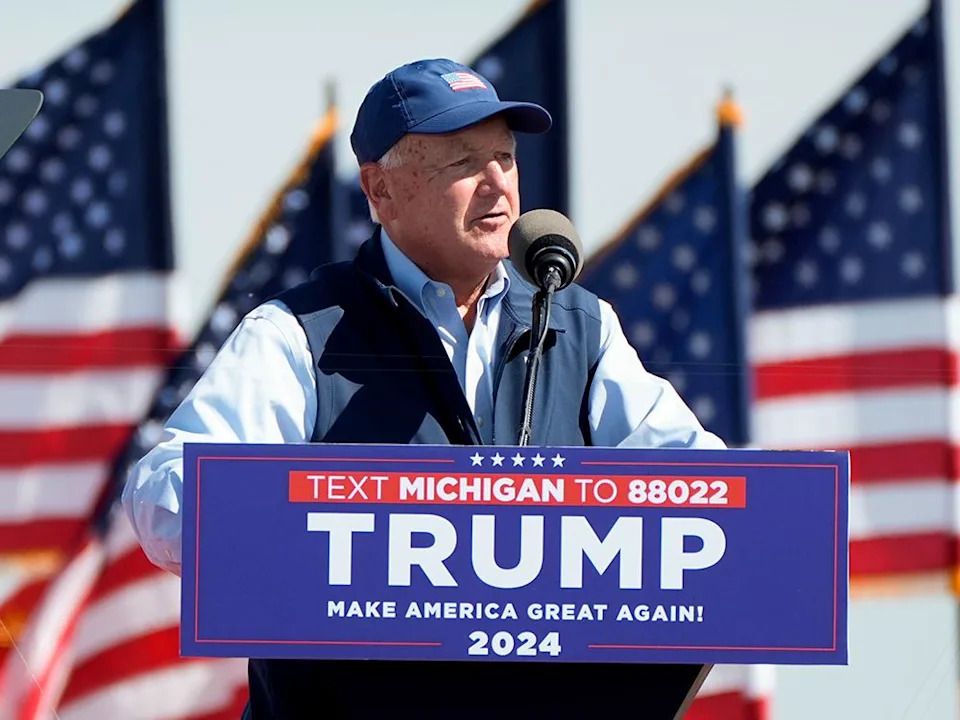
Pete Hoekstra, then Michigan Republican Party chairman, speaks at a Donald Trump campaign rally in Freeland, Mich., May 1, 2024.
A few years later Trump was vying to be president, with Hoekstra’s “close friend” Mike Pence as his running mate. Trump’s staff asked Hoekstra to co-chair the campaign in Michigan. He reminded them that the role usually fell to a sitting member of Congress. That’s true, the aides told him, but all the state’s Republican lawmakers had turned down the job.
Advertisement
Advertisement
Advertisement
Advertisement
“People forget, but back then, Republican congressmen who were on the ballot, they had no idea whether being aligned with Trump or not, what the impact would be on their campaign.”
Trump won a slim, unexpected victory in the state and later named Hoekstra ambassador to the Netherlands. But his first stab at diplomacy started in rocky fashion.
A reporter for Holland’s public broadcaster asked him about his comments on alleged Muslim no-go zones and the burning of cars and politicians, assertions that the Dutch widely rejected. Hoekstra denied he’d ever said such a thing, calling it “fake news.” The journalist then showed him – and later broadcast to TV viewers – a clip of the ambassador saying exactly that.
The State Department repudiated the comments and the ambassador apologized.
Advertisement
Advertisement
Advertisement
Advertisement
The posting ended when Joe Biden captured the White House in 2020, but four years on Hoekstra was back in the political fray, chairing the Michigan party and helping pave the way for Trump’s return to office.
Hoekstra says he had his eye on the Ottawa job in part because of his ties to this country – he had an aunt and uncle who lived in B.C. and Alberta, his wife has a sister who called Smithers, B.C., home and an uncle who was a pastor in St. Catharines, Ont. Hoekstra almost took a job in Guelph, Ont., after obtaining his MBA in the late 1970s. He also cites the fact Canadian troops liberated his parents’ city in the Netherlands during the Second World War and that Canada is a huge trading partner of America’s.
As his Mar-a-Lago one-on-one with Trump ended, the president invited Hoekstra and his wife into a meeting with his core transition team, including Vice President JD Vance by Zoom, and the deal was sealed.
The appointment began on a positive note. Hoekstra told his Senate confirmation hearing in March that “I recognize Canada’s longstanding friendship, our deep economic ties and our strong military alliance.” He touted his good, bipartisan relations with Democratic ambassadors who came after him in the Netherlands and before him in Canada, and said Trump’s priorities were “freer, fairer trade.”
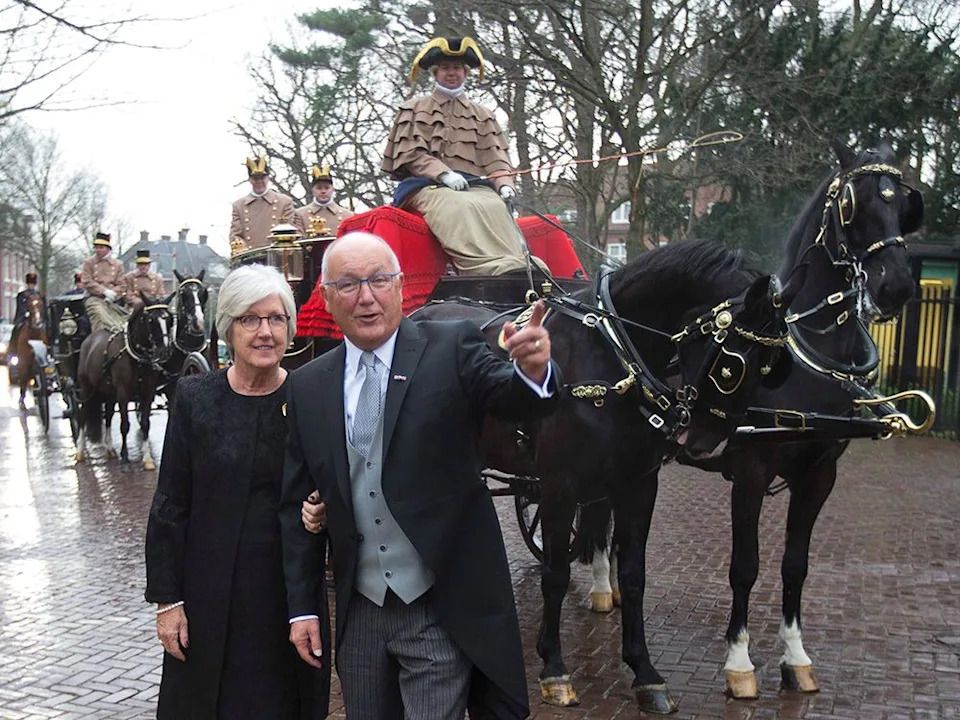
Pete Hoekstra, with his wife Diane, arrive at their residence in The Hague to start his stint as U.S. ambassador to the Netherlands, Jan. 10, 2018. As it is in Canada, his time in the Netherlands was also not without some controversy.
A Democratic senator asked if he agreed that Canada “should not be even jokingly referred to” as part of the U.S. “Canada is a sovereign state,” Hoekstra replied.
Advertisement
Advertisement
Advertisement
Advertisement
Even so, Volpe said the ambassador was “still repeating the president’s annexation language” during their first private meeting to discuss trade issues. Hoekstra later suggested publicly that Trump’s 51st state musings were “a term of endearment,” something few Canadians seemed to swallow.
He says now that promoting annexation was never part of his remit as ambassador and feels both Trump and Prime Minister Mark Carney have long since moved past the issue.
Even so, Trump went beyond just suggesting Canada join the U.S. and calling then-prime minister Justin Trudeau “governor.”
When asked if he would use military force against his northern neighbour, the president said “economic force” would be his preference, and encouraged getting rid of the “artificially drawn line” between the countries. Meanwhile, Trump imposed 35-per-cent tariffs on goods not covered by the countries’ free-trade agreement, as well as crushing new tariffs on aluminum, steel, copper and lumber that also apply to other nations. Despite Hoekstra’s suggestion that the president wanted “freer, fairer” trade, Trump has touted tariffs as a way to shift jobs to the States, and said the U.S. simply does not need most of what Canada exports.
Some diplomats might have tried to soothe the anger, if only to bolster their government’s position. Hoekstra appeared uninterested in coddling.
He said he didn’t understand the bitterness and lamented that “it is very, very difficult to find Canadians who are passionate about the American-Canadian relationship.” The ambassador scoffed at what he called “anti-American” campaigning in the last federal election, and said it was understandable the White House considers it “nasty and mean” of some provinces to ban American alcohol and for Canadians to curb travel to the States.
His strongest pushback, though, came after the Ontario government paid for an ad on American television made up almost entirely of clips of former president Ronald Reagan decrying the idea of tariffs. The TV campaign prompted Trump to halt trade talks with Canada and threaten to slap on another 10-per-cent tariff.
“I recognize Canada’s longstanding friendship, our deep economic ties and our strong military alliance,” U.S. Ambassador to Canada Pete Hoekstra had said at his Senate confirmation hearing.
In public, Hoekstra said “you do not come into America and start running political ads – government-funded political ads – and expect that there will be no consequences or reaction.”
At the Canadian American Business Council gala – traditionally a forum for cross-border bonhomie – he angrily laid into Ontario’s Washington trade representative about the commercial, according to reports quoting unnamed sources in the Toronto Sun, Globe and Mail and CBC.
The trade official, David Paterson, declined to comment on the episode, telling the National Post “we need our ambassadors to be successful problem solvers – and I wish him well.”
Despite all the controversy, Canadians are wrong to think of Hoekstra as prickly or antagonistic, says Emerson about his friend.
“He’s not an abrasive person at all. He’s a very friendly guy,” said the think-tank head. But Hoekstra “didn’t suffer fools very lightly. He was always someone who was very direct. He didn’t hold back in terms of saying something that needed to be said.”
Volpe concedes the ambassador is, in fact, a more reasonable and likeable fellow in private.
Hoekstra stressed in the interview that Canada is being treated no worse than any of the other countries facing Trump tariffs. And yet he said his impression from speaking to fellow U.S. ambassadors around the world is that Canada has reacted with “unique” vehemence.
Hoekstra said trade talks will resume sooner or later and he’s made suggestions to the Carney government on how to proceed. Canada can try against tough odds to avoid any U.S. trade barriers at all or, he said, “If you want to negotiate for the lowest tariffs of any country in the world … you may have a great case.”
Meanwhile, the ambassador says that he can literally pick up the phone and call or text Trump when needed.
Hoekstra’s performance may end up being judged brilliant, bullheaded or something worse. Whatever the verdict, says David Haglund, a Queen’s University international relations professor, it looks like one for the history books.
Arguably the last time an American diplomat created so much fuss here was more than six decades ago, he said, when John F. Kennedy’s ambassador – Walton Butterworth – issued a news release with “corrections” on a speech by then prime minister John Diefenbaker. Diefenbaker was livid at the Americans, said Haglund.
But the expert on Canada-U.S. relations believes Hoekstra’s lot as an ambassador has few if any precedents. He’s had to be the front man here for both a major eruption of American protectionism and talk of annexing Canada, something not heard from a U.S. president since the 19th century.
“He’s got to walk a tightrope,” said Haglund. “If he tries to inject too much rationality into the discussion, he gets zapped by Trump.
“I’m not going out of my way to defend him, but I feel a bit of sympathy for the predicament he’s in,” the Queen’s professor added. “I’m sure when he showed up in Ottawa he didn’t think he’d become the most controversial U.S. ambassador in history.”
Our website is the place for the latest breaking news, exclusive scoops, longreads and provocative commentary. Please bookmark nationalpost.com and sign up for our daily newsletter, Posted, here.
تم ادراج الخبر والعهده على المصدر، الرجاء الكتابة الينا لاي توضبح - برجاء اخبارنا بريديا عن خروقات لحقوق النشر للغير


