

اخبار العرب-كندا 24: الخميس 11 ديسمبر 2025 05:56 صباحاً
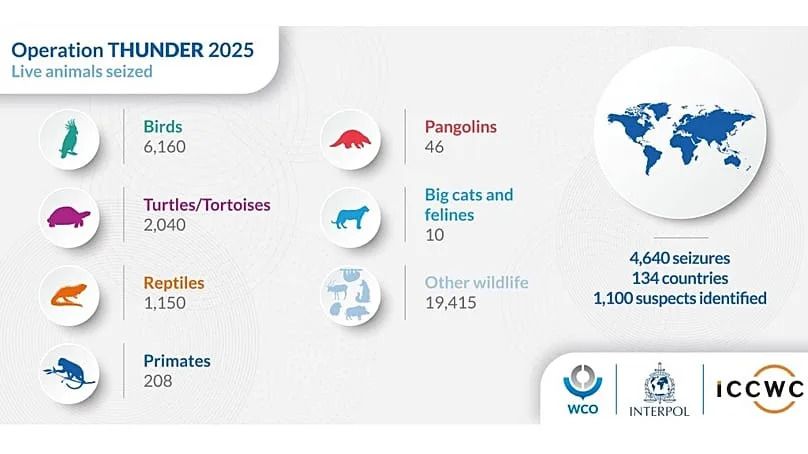
Almost 30,000 live animals have been seized following a global operation against the illegal trafficking of wild fauna and flora.
Following months of preparation, law enforcement agencies, including police, border security, and wildlife authorities from 134 countries, shared intelligence to identify and disrupt “sophisticated” criminal networks.
Known as Operation Thunder, and coordinated by INTERPOL and the World Customs Organisation (WCO), the collective effort saw a record-breaking 4,460 seizures from 15 September to 15 October.
Advertisement
Advertisement
Advertisement
Advertisement
This includes tens of thousands of protected animals and plants and tens of thousands of cubic metres of illegally logged timber, as well as more than 30 tonnes of endangered species of wild fauna and flora. A staggering 1,100 suspects were identified.
Inside Operation Thunder’s latest sting
The investigation found record-high levels of live animals being smuggled across borders were mainly driven by the growing demand for exotic pets.
This includes authorities in Qatar arresting an individual attempting to sell an endangered primate for $14,000 (approximately €11,967) on social media.
However, most wildlife trafficking involves animal remains, parts and derivatives that are used in traditional medicine and speciality foods – with the sting revealing the “escalating” trade of bushmeat(exotic wild animals that have been killed for their meat).
Statistics from Operation Thunder 2025. - INTERPOL.
Belgian authorities intercepted primate meat, Kenyan officials seized more than 400 kilograms of giraffe meat, and Tanzanian law enforcement recovered zebra and antelope meat and skins valued at around $10,000 (approximately €8,550).
Advertisement
Advertisement
Advertisement
Advertisement
Globally, the investigation seized a record-breaking 5.8 tonnes of bushmeat, warning of “notable increases” in cases from Africa into Europe.
Operation Thunder also uncovered an increase in the trafficking of marine species, with more than 245 tonnes of protected marine wildlife seized during the week-long sting.
This included 4,000 pieces of shark fins, which are seen as a culinary delicacy in parts of Asia and often used as a status symbol at events like weddings. They’re also used in traditional Chinese medicine due to their alleged health benefits.
Advertisement
Advertisement
Advertisement
Advertisement
Law enforcement cracked down on the on-going demand for ivory, which is often used for luxury goods such as decorative art and jewellery. French customs seized 107 pieces of ivory from marketplaces, while Austrian customs raided an ivory dealer’s home and recovered six more pieces.
In Germany, more than 1,000 illegal wildlife and forestry items, including ivory, reptile parts, coral, plant derivatives and live specimens were recovered – mainly from mail centres and airports.
Environmental crimes risk ‘destabilising food chains’
It is not just large animals that are being targeted by environmental criminals. Almost 10,500 butterflies, spiders and insects – many of which are protected species – were seized worldwide.
This includes more than 40 shipments of insects and 80 shipments of butterflies originating in Germany, Slovakia and the UK being intercepted at a US mail centre.
Advertisement
Advertisement
Advertisement
Advertisement
INTERPOL says that while these creatures are tiny, they play “vital ecological roles”. Removing them from their natural habitat risks destabilising food chains and introducing invasive species and diseases.
The illegal plant trade also reached record levels this year, with more than 10 tonnes of live plants and plant derivatives confiscated by officials. Experts warn that horticultural and collector markets are driving the demand.
Bringing down criminal networks
“Operation Thunder once again exposes the sophistication and scale of the criminal networks driving illegal wildlife and forestry trade – networks that increasingly intersect with all crime areas from drug trafficking to human exploitation,” says INTERPOL’s Valdecy Urquiza.
“These syndicates target vulnerable species, undermine the rule of law and endanger communities worldwide.
Urquiza adds that INTERPOL is committed to strengthening global policing responses and dismantling the “entire ecosystem of illicit activity” to protect the planet’s natural and human heritage.
تم ادراج الخبر والعهده على المصدر، الرجاء الكتابة الينا لاي توضبح - برجاء اخبارنا بريديا عن خروقات لحقوق النشر للغير


