


اخبار العرب-كندا 24: الخميس 8 يناير 2026 08:08 مساءً
In three trading days on the Toronto Stock Exchange to start this week, Canada’s largest oilsands companies shed a combined $14 billion in stock market value, before notching a partial comeback Thursday — dropping the figure to about $8.3 billion.
Canadian conventional oil producers and oilsands operators took a pummelling Wednesday in the aftermath of U.S. President Donald Trump writing on social media that Venezuela will turn over up to 50 million barrels of oil to the United States to sell.
It came after U.S. forces captured Venezuelan President Nicolas Maduro on Saturday, and Trump has laid out plans for the country’s oil sector.
Advertisement
Advertisement
Advertisement
Advertisement
On Thursday, the Wall Street Journal reported Trump informed his aides that these efforts could help reduce oil prices to US$50 a barrel. U.S. Energy Secretary Chris Wright said Venezuelan oil production could increase from about 800,000 barrels per day (bpd) to 1.2 million bpd in fairly short order.
“I think a year from now, it could be 50 per cent higher,” Wright told Fox News.
There are plenty of complex questions to answer in the coming months on how quickly production from Venezuela can increase, how much capital it will require, and what it will mean for the global oil industry, including Canadian producers.
Venezuela has the world’s largest oil reserves, and its heavy oil is similar and competes with Canadian crude — but the country will need substantial investment to significantly boost output.
Advertisement
Advertisement
Advertisement
Advertisement
Yet, the reaction from investors was immediate — and largely negative — for domestic producers, focused on concerns Canadian heavy oil could lose market share in the U.S. Gulf Coast to Venezuela, and a potential larger discount for Western Canadian Select (WCS) crude.
“I think there was an overreaction (in) the public traded markets on the announcement. The drop in share prices was not justified. Overall for the sector, it’s not positive, but it’s neutral in the near term,” Whitecap Resources CEO Grant Fagerheim said Thursday in an interview.
“There has to be more clarity as to what is not just the perceived impact, but the real impact. And we won’t find that out for a period of time.”
Whitecap Resources CEO Grant Fagerheim.
On Wednesday, the share price of Canadian Natural Resources, the country’s largest producer, fell 2.8 per cent on the Toronto Stock Exchange, down 10 per cent since the start of the week, while Cenovus Energy was off 2.1 per cent, and had dropped almost nine per cent since Monday — although both gained back ground on Thursday.
Advertisement
Advertisement
Advertisement
Advertisement
“What (investors) expect is at some point, Venezuela is likely to increase production and, if they do, it could push some of the heavy oil barrels out of the market,” said Laura Lau, chief investment officer with Brompton Group.
The S&P/TSX Capped Energy Index, which rose by more than 12 per cent last year — even as oil prices dipped — is still down almost four per cent this week.
“The issue is one of sentiment,” said Menno Hulshof, an analyst at TD Cowen.
“This time last week, it was all very bullish . . . A lot of that positive sentiment has exited the sector now.”
Related
Advertisement
Advertisement
Advertisement
Advertisement
On Thursday, stock in many Canadian petroleum producers rallied as oil prices rose, with Cenovus shares up 3.4 per cent, Canadian Natural rising 3.1 per cent, Baytex Energy up 6.9 per cent and Whitecap stock increasing 2.5 per cent.
Prices for West Texas Intermediate (WTI) crude increased $1.77 a barrel to close at $57.76 on Thursday.
According to Bloomberg data compiled by TD Cowen, four large oilsands producers — Canadian Natural, Cenovus, Imperial Oil and Suncor Energy — collectively saw their market capitalization drop about $14 billion between Friday’s close and Wednesday amid the turmoil in Venezuela, although integrated producer Suncor was up slightly.
After Thursday’s rally, their combined stock market value was down $8.3 billion, or about three per cent, this week, with Suncor and Imperial up about one per cent each.
Advertisement
Advertisement
Advertisement
Advertisement
“I think the big fear is that of timing. A lot of people don’t want to wait around for the next year, year-and-a-half, two years, to better understand how all of this is going to play out,” added Hulshof.
It’s unclear how long it will take for the 50 million barrels of oil that Trump referenced to reach the U.S., and whether it would ultimately make its way to Gulf Coast refineries that currently use Canadian heavy oil.
However, the price differential between WTI and Western Canadian Select (WCS) heavy oil widened to US$14.56 a barrel on Wednesday, according to TD Cowen.
“The U.S. Gulf Coast can take about 600,000 more barrels of Venezuelan crude, based on the analysis we’ve done . . . There will be some downward pressure on WCS. We’re not expecting it to be a huge amount,” Amrita Sen, research director of London-based consultancy Energy Aspects, said in an interview Thursday.
Advertisement
Advertisement
Advertisement
Advertisement
“The Canadian sell-off is probably a little bit overdone.”
She estimated the volume of Canadian oil that could be “backed out” of the U.S. Gulf Coast by Venezuelan crude would be about 100,000 to 200,000 bpd.
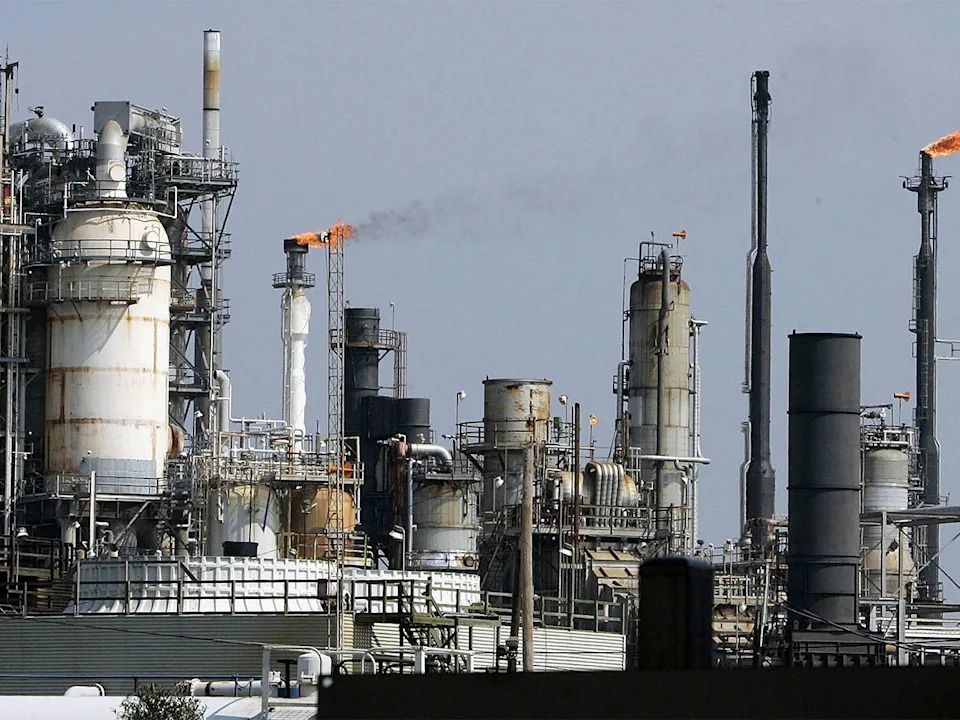
This file photo taken on Sept. 22, 2005, shows an oil refinery on Galveston Bay in Texas City, Texas.
Meanwhile, the vast majority of Canadian oil will continue moving into the U.S., although some product is heading through the Trans Mountain system into Asia.
“The Canadian crude is hardwired into the U.S. system, so that the Canadian egress system predominantly points south,” said Kevin Birn, an analyst for S&P Global Commodity Insights.
“A rejuvenation of Venezuela means Canada will have a competitor. But the market is huge and ultimately the price of oil globally . . . is going to be more impactful.”
Advertisement
Advertisement
Advertisement
Advertisement
Whitecap, a light oil and natural gas producer active in Western Canada, will remain disciplined with its capital allocation amid the market turbulence, said Fagerheim.
The company’s share price is down about 6.5 per cent this week, and the veteran CEO said investors are looking for more clarity on the situation in Venezuela, as well as from Ottawa on getting more Canadian product to market.
“For a period of time, I think there’s a pause for everyone to figure it out . . . We got caught in the vortex of talking about heavy oil, and we’re not even a heavy oil producer,” he added.
“I was very excited about 2026, coming out of 2025. We will just have to see how this plays out.”
Chris Varcoe is a Calgary Herald columnist.
cvarcoe@postmedia.com
تم ادراج الخبر والعهده على المصدر، الرجاء الكتابة الينا لاي توضبح - برجاء اخبارنا بريديا عن خروقات لحقوق النشر للغير


