


اخبار العرب-كندا 24: الاثنين 29 ديسمبر 2025 06:20 مساءً
In the immediate aftermath of Donald Trump’s Sunday meeting with Ukrainian President Volodymyr Zelenskyy, the U.S. president said he spoke with the leaders of France, Finland, Poland, Norway, Italy, the U.K. and Germany, as well as the presidents of NATO and the European Commission.
Canada was notable by its absence, despite committing an additional $2.5 billion in financing and loan guarantees to Ukraine just a day earlier.
“The Liberals have sent billions to Ukraine and get zero respect. Elbows up!” mocked conservative digital strategist and social media influencer Jeff Ballingall.
Advertisement
Advertisement
Advertisement
Advertisement
It was more redolent of times when Canadians tended to look surprised when they were invited to big meetings than the modern image of a government that is “building Canada strong.”
One official suggested Prime Minister Mark Carney’s absence from that particular call was more logistical than conspiratorial.
“Organizing these calls is a bit of a gong show,” said the official.
The call referred to by Trump was with the “E3+”, the contact group between what has become known as the “coalition of the willing” and the White House. Canada has dipped in and out of that group, the official said.
But the official said that, over the preceding 72 hours, the prime minister’s national security advisor, Nathalie Drouin, Foreign Affairs Minister Anita Anand and Carney have all been involved in calls with the Americans, Ukrainians, British and the European Union. “We’re deeply immersed in this,” said the official, who added the president and the prime minister are in regular contact.
Advertisement
Advertisement
Advertisement
Advertisement
Zelenskyy stopped in Halifax to meet with Carney on his way to Washington. The meeting was at the request of the Ukrainians, who are already looking for help with energy and critical minerals for when, or if, the Russia conflict is resolved.
For the Ukrainians at least, Canada is considered a key partner, as it should be, given it has committed to providing $24.5 billion in assistance since 2022.
For comparison purposes, the Kiel Institute’s Ukraine Support Tracker to the end of October lists Canada as the sixth-largest donor at US$15.23 billion, of which US$9.6 billion is in financial aid and US$4.99 billion in military support. (The U.S. is tops, followed by the European Union, Germany, the U.K., and Japan.).
A vocal minority of Canadians have complained about the cost to taxpayers, even though former defence minister Jason Kenney has pointed out that the incremental cost is far lower than $24.5 billion. As he has said, nearly half the commitment is in loans and much of the military support is a notional accounting value of end-of-life equipment that is being transferred.
Advertisement
Advertisement
Advertisement
Advertisement
What is apparent to anyone who has studied the issue for more than five minutes is that Russia’s Vladimir Putin believes he is on a divine mission to reconstitute Peter The Great’s empire, which would encompass much of the Baltic states. In discussing Peter’s Great Northern War with Sweden (1700–1721), Putin said Russia did not take anything from the Swedes; the czar was simply reclaiming Russia’s territory. “Clearly, it fell to our lot to return and reinforce as well,” he said in June 2022.
As former chess champion and ardent Putin opponent Garry Kasparov said on social media: “If you think supporting Ukraine winning is expensive, it’s nothing compared to the cost of Ukraine losing.”
A poll earlier this month for Politico suggested a clear majority of Canadians concur, with 35 per cent urging more support for Ukraine, 34 per cent calling for current levels to be maintained and only 22 per cent advocating for less aid.
Carney has made the case that Ukraine’s cause — “freedom, democracy, sovereignty” — is Canada’s cause too.
Advertisement
Advertisement
Advertisement
Advertisement
Canadians, it seems, appreciate that if Putin were emboldened by victory in Ukraine, he would turn to the Baltics, where Canada leads a multinational brigade in Latvia.
Anyone who witnessed in their formative years the collapse of the Soviet Union, thanks to a policy of determined deterrence, must surely conclude that Europe and Canada can win another arms race against Russia — even without the Americans.
That is certainly the belief of those who know the Russians best. Such as the director general of the Estonian Foreign Intelligence Service, Kaupo Rosin, who offered his views on Monday to ERR, the English-language service of the country’s public broadcaster. Rosin said Russia has no intention of attacking the Baltic states at the moment because of NATO’s strong response to incidents like airspace violations and undersea cable sabotage.
He said Russia’s interest lies in slowing down Europe’s movement toward rearmament and pointed out that Putin has even stated Russia could write into legislation that it has no intention of attacking Europe.
Advertisement
Advertisement
Advertisement
Advertisement
Moscow is also seeking relief from sanctions that are forcing it to sell its energy at a discount.
Rosin said Russia is not going to collapse any time soon but the pressures of war are beginning to take a toll. “Things are moving in the right direction for us,” he said.
That might explain the optimism Trump was spouting at Mar-a-Lago on Sunday, where he said: “I think we’re in the final stage of talking.”
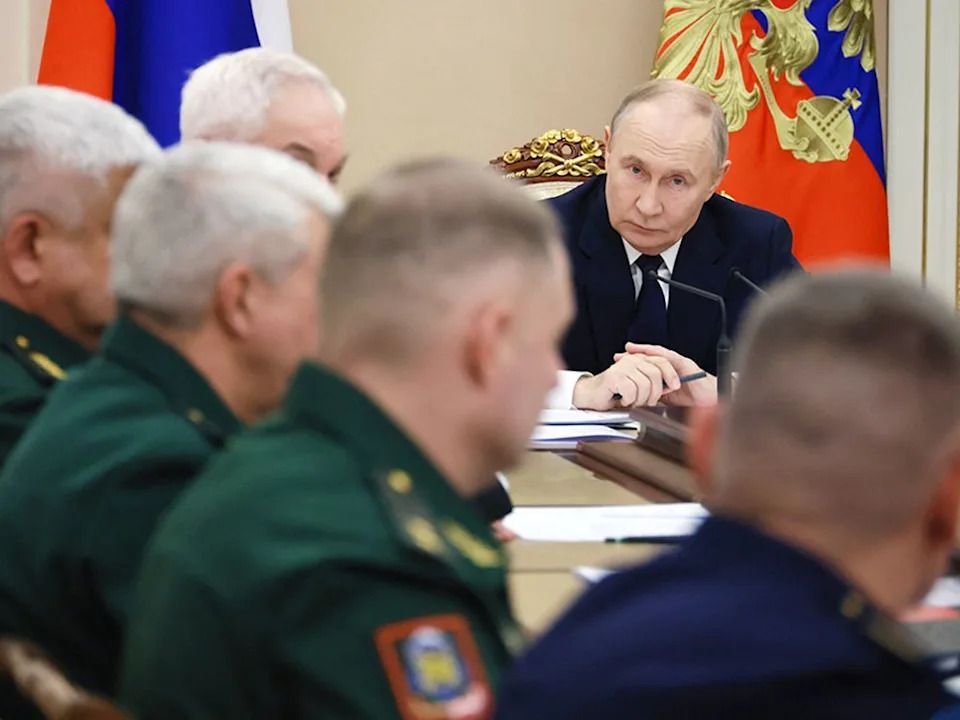
Russia’s President Vladimir Putin chairs a meeting on situation in the zone of the “special military operation”, the Kremlin’s term for the nearly four-year-long Ukraine war, in Moscow on Dec. 29, 2025.
Zelenskyy discussed aspects of the 20-point peace plan he presented, perhaps more in hope than expectation. He said U.S.-Ukraine security guarantees have been agreed to and that Europe’s guarantee is almost agreed.
Advertisement
Advertisement
Advertisement
Advertisement
The sense that Trump is being manipulated by Putin remains inescapable. How could anyone suggest, as the U.S. president did, that the Russians “want Ukraine to succeed” at the same time as Moscow was raining down ballistic missiles on Kyiv?
Trump talked about going through the “Russia-Russia-Russia hoax” alongside Putin, as if they were comrades in arms.
“I believe him … and I think we’re going to get there,” he said.
To put the most generous spin on this, Trump wants a peace deal and thinks the quickest way to achieve it is to bully the weaker player: Zelenskyy.
But if he truly believes Putin wants peace, it’s because he has a bullshit blind spot, which psychology research suggests is a real thing for overconfident people with an indifference for the truth.
Advertisement
Advertisement
Advertisement
Advertisement
As Estonia’s Rosin noted, finding a new external enemy may be necessary for Putin and his regime, even if he ends the war in Ukraine.
Fortunately, he noted that Russia still respects NATO. “Our trick is to keep it that way… a year from now, and three, five or 10 years into the future. To achieve that we have to invest in our defence, meaning Estonia, meaning the European Union and NATO. Keeping the situation as it is today requires significant effort.”
Simply put: staying the course with Ukraine is the right thing to do.
National Post
jivison@criffel.ca
تم ادراج الخبر والعهده على المصدر، الرجاء الكتابة الينا لاي توضبح - برجاء اخبارنا بريديا عن خروقات لحقوق النشر للغير


