


اخبار العرب-كندا 24: السبت 27 ديسمبر 2025 10:44 صباحاً
The commander of the Royal Canadian Navy is floating the idea of an ice-capable amphibious landing ship to move troops and equipment around the country’s Arctic — and perhaps elsewhere.
But Vice-Admiral Angus Topshee is quick not to get his hopes up — and has even, occasionally, taken pains to downplay it.
At various times, Topshee has described the notion as “a conceptual thing" and even told a podcaster last fall that it is “a thought exercise” — part of the imagining that’s going on as the navy and the defence establishment writ large wraps their heads around an era of bigger ambitions and bigger budgets.
Advertisement
Advertisement
Advertisement
Advertisement
However, it is a conceptual thing that’s been the subject of preliminary conversations between naval planners and two of the country’s shipyards: Davie Shipyard in Lévis, Que., and Seaspan in Vancouver. Both are already building the Canadian Coast Guard’s new icebreaker fleet.
Each of the companies have notional ideas — even proposals — that could be modified to create an all-Canadian designed-and-built landing ship for Far North operations.
“We talked to a couple of our shipbuilders, and they've said that theoretically a Polar Class 2 amphibious ship would be possible,” Topshee said in a year-end interview with CBC News. “The key value proposition of an amphibious ship is it can deliver capability from sea to shore without prepared port infrastructure, and that describes our North perfectly."
In theory, that means one big ice-capable ship that carries both smaller landing craft (likely hovercraft) and helicopters. A number of Canada’s allies operate such ships. The difference is almost none of them are built for northern operations.
New funding will allow military to dream big
Going into 2026, it’s widely anticipated that the federal Liberal government will deliver a new defence policy at some point. The reset is something Prime Minister Mark Carney promised when he announced in June that Canada would meet NATO’s spending target of two per cent of GDP by the end of this budget year.
Advertisement
Advertisement
Advertisement
Advertisement
Topshee said the concept could feed into a defence policy review.
Canada is committed to spending up to five per cent of its gross domestic product (3.5 per cent directly on the military and 1.5 per cent on defence infrastructure) — or roughly $150 billion annually. The move will take place over the next 10 years but will be reviewed in 2029 to ensure those targets still align with the threats Canada is facing.
The influx of funding has allowed the military’s senior leaders the freedom to consider things that might not have been possible even a year ago.
Topshee has also been widely quoted as advocating for an entire new class of corvettes — on top of the existing fleet of Arctic and offshore patrol vessels and the new River Class destroyers, which are just beginning construction in Halifax.
Advertisement
Advertisement
Advertisement
Advertisement
But it is the notion of an ice-capable landing ship that could prove to be the most ambitious, yet also potentially the most useful as the country tries to demonstrate its sovereignty in the Far North to both friends and foes alike.
“We've done a study of the North, [and] one of the things that becomes clear is that in North America, there's only one year-round ice-free port, and that's in Nuuk, Greenland,” Topshee said.
“As we went through that analysis, we examined what would happen if we had a small [Canadian] community in distress in the High Arctic in February. How could we get capability there?"
Countries tie amphibious ships to national security
The Canadian military has become good at improvising solutions, much as it did in 2010 when responding to the deadly earthquake in Haiti. Relief troops were sent via air, but a rented cargo ship containing all of their vehicles and equipment couldn’t be put ashore in the destroyed port. So it was dropped off in the Dominican Republic, and transport planes had to fly everything individually into Haiti.
Advertisement
Advertisement
Advertisement
Advertisement
Being able to move troops and equipment and sustain them — either in the Arctic or elsewhere — has been a major preoccupation for the military for decades. Canada has often relied on allies or rented the capability it needs.
“To sustain an operation up in the North, we sort of realized that some form of Arctic mobile base probably made a lot of sense, and that is effectively what an amphibious ship is," Topshee said.
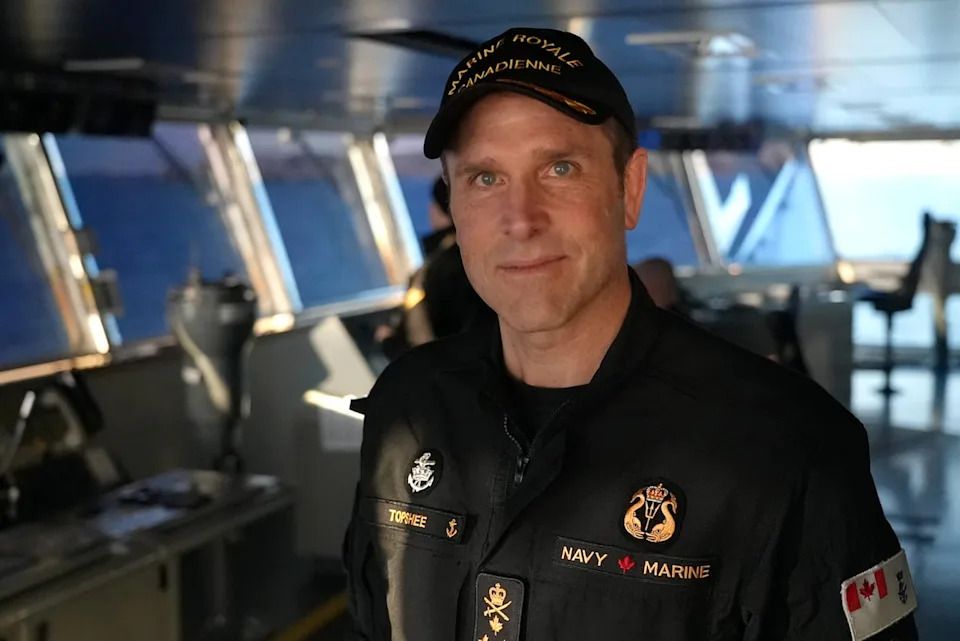
Vice-Admiral Angus Topshee, commander of the Royal Canadian Navy, is shown on-board HMCS Margaret Brooke, in Antarctica in March. (Sam Martin/CBC)
The discussion in Canada about procuring an amphibious support or assault ship is not new. It has persisted for more than 20 years but never solidified into a firm defence policy or substantial political commitment.
The idea gained traction in the early 2000s, but politically the concept repeatedly collided with fiscal and institutional realities.
Advertisement
Advertisement
Advertisement
Advertisement
In 2015, then-defence minister Jason Kenney explored the possibility of buying a French Mistral-class helicopter carrier that had been built for Russia but was blocked due to Ukraine sanctions. Talks went on until the federal election halted those negotiations, leaving the ship to be snapped up by Egypt instead.
Other allied countries are also heading in a similar direction, tying amphibious ships to their national security strategies. Australia explicitly did so recently, seeing the capability as important to regional leadership and disaster response.
The United Kingdom recently decommissioned its two amphibious warfare ships: HMS Albion and HMS Bulwark. It is planning to construct Multi-Role Support Ships (MRSS) to replace them.
Japan, despite domestic sensitivities, incrementally acquired helicopter carriers, arguing they are for defensive and humanitarian purposes.
تم ادراج الخبر والعهده على المصدر، الرجاء الكتابة الينا لاي توضبح - برجاء اخبارنا بريديا عن خروقات لحقوق النشر للغير


