




اخبار العرب-كندا 24: الثلاثاء 23 ديسمبر 2025 05:32 مساءً
Some energy experts are challenging N.B. Power’s claim that a proposed billion-dollar power plant is needed to avoid an electricity shortage predicted for 2028.
Instead, they say, the utility could tackle its predicted shortage by reducing demand.
Demand-side management is a catch-all term for a collection of technologies and programs that help reduce the amount of electricity people use and spread out the times of day they use it.
Advertisement
Advertisement
Advertisement
Advertisement
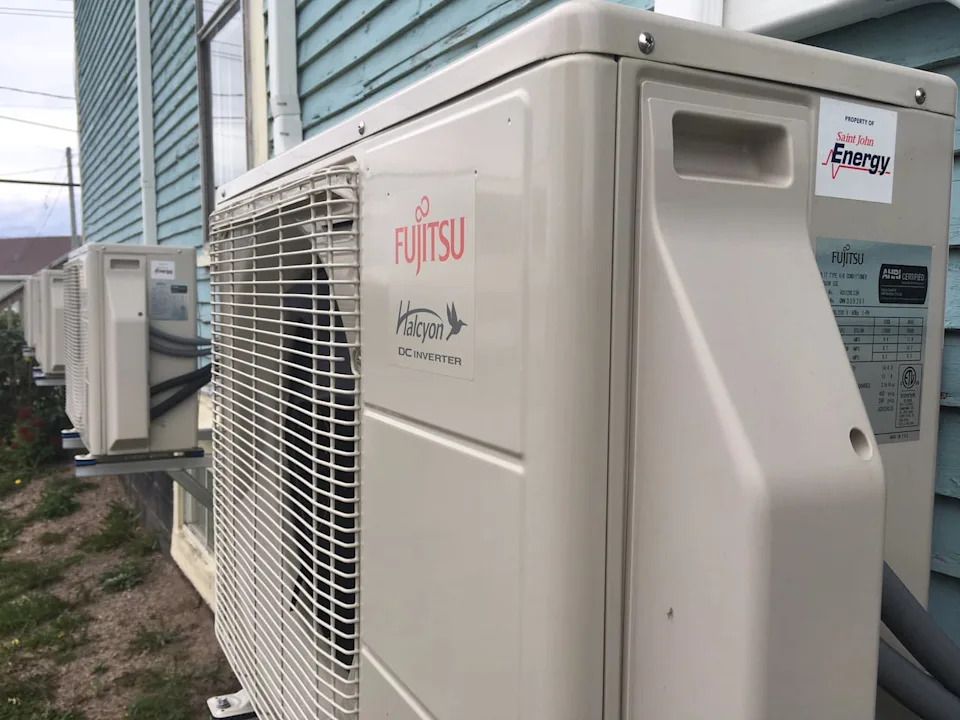
It starts with things like “simple insulation” to reduce overall heating demand, said Brendan Haley of Efficiency Canada. Then there’s technology like cold weather heat pumps.
An N.B. Power program to help low income households get insulation and heat pumps installed has a two-year wait list. (Robert Jones/CBC)
In 2023, about 30 per cent of New Brunswick households still relied on electric baseboard heaters, according to Statistics Canada.
That number has been dropping thanks to programs like N.B. Power’s total home energy savings program, which pays incentives to people doing things such as stalling insulation and heat pumps.
Nearly 29,000 households have completed upgrades using the program since 2018, but another 31,000 applications are either incomplete or in the pipeline. The program has yet to exceed its annual budget, which will be about $16 million in 2026.
Advertisement
Advertisement
Advertisement
Advertisement
Another N.B. Power program, which targets low-to-medium-income households is facing budget constraints.
The enhanced energy savings program fully covers costs of insulation and heat pumps for households with incomes below $70,000.
The program saw nearly 34,000 applications in the past three years. As of September, 21,000 applications remained incomplete, and there is a two-year wait.
The good news, Haley said, is that a recent study commissioned by N.B. Power shows that the utility could double energy efficiency efforts and remain cost effective.
“It is lower cost over the long term to save that energy than it is to spend on the supply side."
Target less than half of Nova Scotia’s
N.B. Power does some demand-side management but could do more, according to Haley.
Advertisement
Advertisement
Advertisement
Advertisement
The utility’s savings target for reducing electricity demand is set to reach 0.75 per cent of electricity sales by 2028. In Nova Scotia, the province hit about 1.5 per cent in savings this year.
“And we see even higher savings than that in some leading states, like Vermont and Massachusetts," Haley said.
What’s worse, he said, is N.B. Power treats its legislated target as a maximum, not a minimum.
“The way New Brunswick did its last electricity planning process is it essentially took that target as a cap,” said Haley. “It said that's all we're going to do.”
“The planning process should allow energy efficiency to be considered as a real alternative to, say, a power plant or a transmission line."
Shaving the peak
Energy efficiency and conservation represent just one facet of demand side management. Another key component is known as demand response, which aims to reduce use of electricity at key times for utilities.
Advertisement
Advertisement
Advertisement
Advertisement
The way people use electricity is not consistent throughout the day or the year.
Electricity consumption climbs dramatically every morning as people get up and start using appliances. There’s another, usually smaller peak in the evening when most people return home from work.
"That's what puts the most stress on N.B. Power,” said Moe Qureshi, director of climate research and policy at the Conservation Council of New Brunswick. “They have to turn on all of their generation to make sure that all the lights and power stays on.”
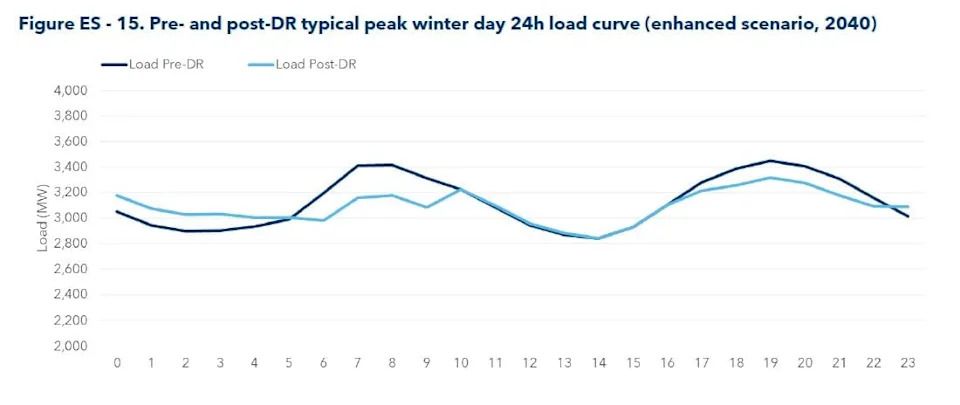
A figure from New Brunswick Demand Side Management Potential Study by Dunsky Energy + Climate. The light blue line represents electricity load after demand response, which shaves the peak represented by the dark blue line. (Dunsky Energy + Climate for N.B. Power)
Demand-response programs encourage people to use less electricity during peak times. Qureshi points to Ontario, where electricity rates are higher at peak times, and lower at off-peak times.
Advertisement
Advertisement
Advertisement
Advertisement
A household doing laundry at 9 a.m. would pay more for power than one waiting until after 8 p.m., said Qureshi. People can also pre-heat their homes and hot-water tanks, or choose different times to charge electric vehicles to avoid peak rates.
“We can start shaving off some of that stress on the grid by having some behavioral changes from people who want a cheaper bill,” Qureshi. “If you start shaving off that peak, you'll soon find that, you know, maybe we don't need more generation."

Moe Qureshi, director of climate research and policy at the Conservation Council of New Brunswick, said peak demand puts stress on N.B. Power operations. (Erica Butler/CBC)
Shediac pilot shows positive results
N.B. Power has demand-response programs for industrial customers, offering a $60/kW incentive payment to large customers who reduce their electricity draw on certain winter mornings. Two programs aimed at industrial customers succeeded in reducing peak demand by over 80 MW in 2024-25.
Advertisement
Advertisement
Advertisement
Advertisement
But N.B.Power has yet to introduce any demand-response programs for residential customers. That’s despite some positive results from a five-year pilot project in Shediac, where customers who were offered only time-of-day discounts saw a 3.3 per cent decrease in their peak demand.
The Shediac pilot included a third aspect of demand response: distributed generation and energy storage.
Some of the 500 homes in the pilot were equipped with solar and battery technology. During peak times, they were programmed to use their stored battery power, or send some of it to the N.B. Power grid. The project summary report notes that those homes achieved up to 75 per cent reduction in peak demand.
The kinds of technology tested in Shediac could essentially serve as a virtual power plant, said Yves Gagnon, a professor of engineering at the Université de Moncton, whose research focuses on the energy sector.
Advertisement
Advertisement
Advertisement
Advertisement
If large numbers of small home-based solar and battery systems could be centrally co-ordinated, Gagnon said, they can serve as one large resource for the utility.
“Virtual power plants are more efficient and cheaper than fossil fuel-based … plants, such as what is proposed in Tantramar to burn natural gas and diesel."
“That's where power systems are going,” he said. “You have distributed generation of electricity, you have storage capacity of electricity, and you manage all of that in an integrated approach by the utilities to satisfy the demand when there is a demand.”
Haley points to N.B. Power’s own commissioned study that shows the potential for demand-side management.
“There's other jurisdictions that are already saving at a level that New Brunswick could get to." Haley said. "It's shown to be cost-effective in New Brunswick to save more energy, and the benefits are quite large."
تم ادراج الخبر والعهده على المصدر، الرجاء الكتابة الينا لاي توضبح - برجاء اخبارنا بريديا عن خروقات لحقوق النشر للغير


