


اخبار العرب-كندا 24: الاثنين 22 ديسمبر 2025 06:44 صباحاً
If you’ve noticed matcha prices nearly doubling in recent years, you’re not alone.
Demand for the Japanese green tea powder has recently surged thanks to social media, making it harder — and more expensive — for tea companies to supply Montreal shops.
Buyer and co-owner of Montreal tea company Camelia Sinensis, Kevin Gascoyne, said he’s “never seen anything like it in the tea world” in his decades of experience.
Advertisement
Advertisement
Advertisement
Advertisement
“In the last two years, it’s just exploded, and it’s gone so large that supply just can’t keep up with the demand for it,” Gascoyne remarked in an interview. Within a year, he says the price of 100 grams of matcha for the company has jumped from $26 up to $46.
A large part of the popularity surge, Gascoyne said, is social media trends, particularly among Gen Z.
“It’s a beautiful combination of caffeine and L-theanine,” an amino acid found in tea that he says reduces stress. “We’ve got this really nice cruise control of stimulated mind and calm body. And this is really popular with young people,” since it can provide energy without making some people fidgety.
Beyond the health benefits, Gascoyne argues “it’s a gorgeous colour, and it makes great Instagram pictures” that contribute to its internet virality.
Hard to scale up
For centuries, matcha was mostly grown in and around Shizuoka, Japan. This is according to Rikko Osaki, founder of Toronto-based tea company Hokusan, which distributes wholesale matcha to several Montreal cafés including Osmo on Sherbrooke St. West.
Advertisement
Advertisement
Advertisement
Advertisement
“We have mild weather. We have Mount Fuji, so good minerals. We also have the ocean,” Osaki said in an interview, speaking of her home town. “It’s perfect for green tea production.”
Tea production in Japan has historically been region-specific, much like French vineyards, according to Gascoyne.
“Matcha uses specific kinds of plants, and most of Japan is set up to produce sencha,” he said. “It’s all the same tea, but within tea, there are different cultivars, which is sort of the equivalent of the cépage and the French wine,” a term referring to the variety of a wine. “There are certain ones that make better senchas, and there’s certain ones that we use for making matcha.”
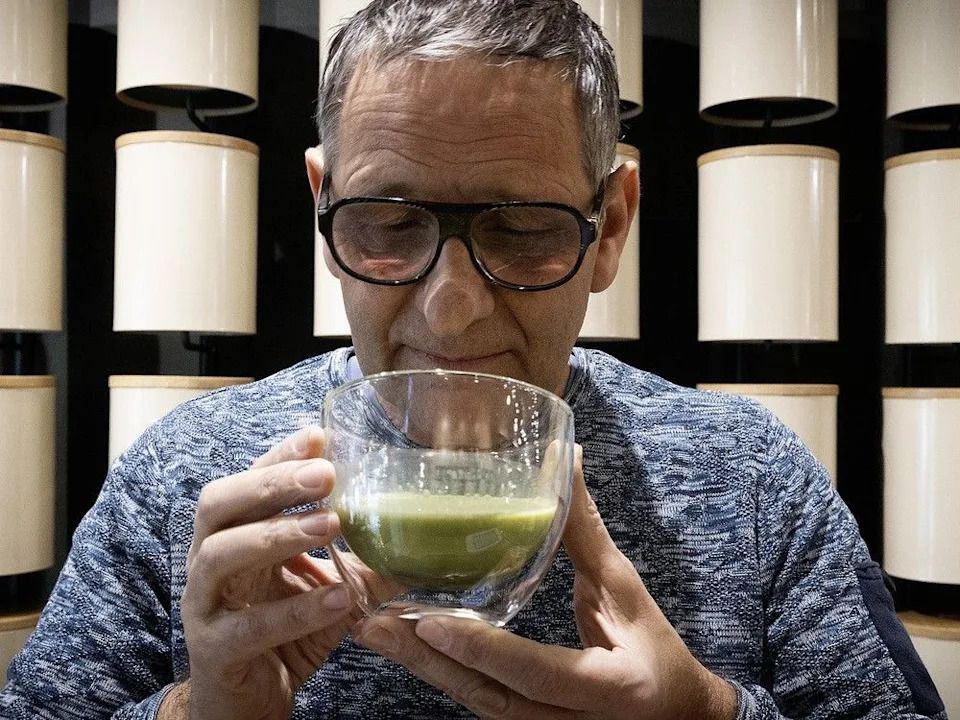
Kevin Gascoyne with a matcha latte at Camellia Sinensis Boutique. The process for producing matcha plants is complex, he says, and it can’t be done quickly from scratch.
Farms having to switch the type of tea they grow and scale up production isn’t a straightforward process, he said.
Advertisement
Advertisement
Advertisement
Advertisement
“Just to pull plants out, prepare the land, put new plants in, prune them until they become part of a plucking table — just that is about five years.”
On top of that, Osaki said farms that have been making tea for centuries are having a hard time convincing younger generations to take over production. The average age of Japanese tea farmers, she said, is at least 70 years old.
A farm she’s worked with is “500 years old, 10th generation. They have three sons. They all got corporate jobs in Tokyo, only because they’ve seen how much physical work it is just to produce a cup of tea.”
Global warming adds another challenge. Osaki said a large proportion of matcha tea crops in Japan died this past spring because “it’s been too hot.”
Advertisement
Advertisement
Advertisement
Advertisement
“It literally burned the tea leaf.”
Moving production to China
In the new year, Camellia Sinensis will branch out by selling matcha from China and South Korea.
“It’s a first for us, and we haven’t done it in the past, because we’ve never had anything that met our quality criteria,” Gascoyne said.
China has been producing what Gascoyne describes as “low-grade matcha” for years. “Most of the large coffee chains, they buy Chinese matcha. And one of the ways you can usually tell, or you could tell, for most like until recently, was the difference in colour. Japanese matcha is bright green, and Chinese matcha is kind of pale grey-green.”
Advertisement
Advertisement
Advertisement
Advertisement
But he and Osaki say China matcha producers have upped their game.
“The Chinese government has been investing in matcha production for the last 30 years,” Osaki said. “This year became their biggest opportunity for the market.”
Slight differences in quality or colour become less detectable when the powder is mixed into a latte or a smoothie. Culinary-grade matcha made to mix with milk is “bolder” than ceremonial-grade matcha, Gascoyne said, and can be ground coarser, similar to producing black tea that is deliberately strong to stand out against sweeteners. The Chinese and South Korean matcha Camellia Sinensis plans to sell is culinary-grade.
Osaki argues matcha’s popularity is more than just a temporary fad, as younger generations make different lifestyle choices.
Advertisement
Advertisement
Advertisement
Advertisement
“They don’t want to drink coffee. Maybe they want to drink matcha instead. Maybe they don’t want to drink alcohol, maybe they’re smoking weed or doing mushrooms instead,” she said.
“You know how coffee is like, coffee is a base, and now that we have matcha … this is going to be like a new normal.”
lschertzer@postmedia.com
Related
تم ادراج الخبر والعهده على المصدر، الرجاء الكتابة الينا لاي توضبح - برجاء اخبارنا بريديا عن خروقات لحقوق النشر للغير


